
Your Story Matters. Your Family Matters. Your Results Matter.


Awards and recognitions listed are not indicative of future results. Selection criteria vary by organization.
Florida Motorcycle Accident Lawyer | Broward County & Fort Lauderdale
Florida Motorcycle Accident Lawyer
When You Were Blamed for a Crash That Wasn’t Your Fault — We Prove What Really Happened.
Florida is the deadliest state in the nation for motorcyclists. When you are injured in a motorcycle crash, the bias starts immediately — at the scene, in the police report, and especially with the insurance adjuster reviewing your claim. Riders are blamed for crashes that weren’t their fault. Helmet choices are used to reduce damages. Citations are treated as case-closing evidence.
We know better. Carlos D. Cabrera was insurance defense counsel before he became a trial Lawyer. He helped develop the playbook insurers use against motorcyclists. Now he defeats it — including the $2.5 million recovery for a rider who was cited at the scene.
When the Ambulance Is the One That Hit You
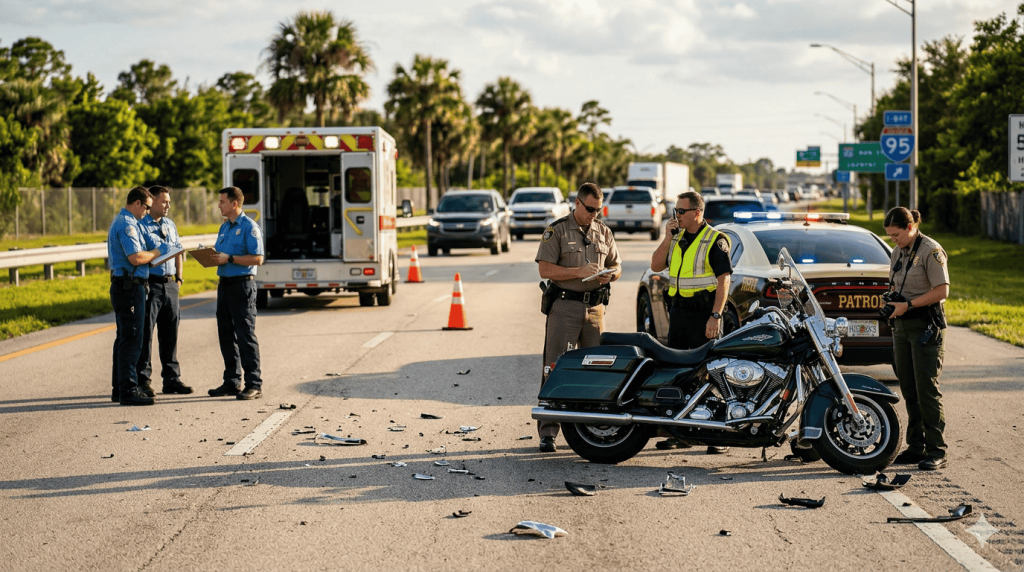
One of our clients was riding his motorcycle behind an ambulance when it stopped short without warning. He collided with the ambulance, flew off his bike, and landed on the windshield of another vehicle. The police cited him at the scene. That citation could have ended his case.
It didn’t. Our team gathered testimony from multiple witnesses who saw the ambulance cut him off and stop suddenly with no warning. We proved the ambulance driver was negligent. The case resolved for $2,500,000.
This case is the reason we tell every motorcycle accident victim the same thing: do not accept what you are told at the scene. Citations, bias, and initial impressions are not the end of your story. Your story matters — and how it is told determines what you recover.
$2,500,000 — Motorcycle vs. ambulance — client cited at scene. Witness testimony proved ambulance liability. Recovered $2.5 million.
Past results do not guarantee future outcomes. Every case is evaluated on its individual facts.
Florida Motorcycle Accident Statistics
Florida is the deadliest state in the nation for motorcyclists. According to the Florida Department of Highway Safety and Motor Vehicles (FLHSMV), in 2023:
Statewide Statistics (2023)
| Statistic | Approximate Annual Figure |
|---|---|
| Florida motorcycle crashes | 9,398 |
| Riders injured | 8,091 |
| Riders killed | 590 |
| Fatality risk vs. cars | 29x higher |
Florida recorded more motorcycle fatalities than any other state in 2023. The numbers are not improving — motorcycle fatalities in Florida increased 18% between 2019 and 2023.
Broward County Statistics (2023)
| Statistic | 2023 Data |
|---|---|
| Motorcycle crashes | 761 |
| Rider fatalities | 37 |
| Rider injury rate | 80%+ of crashes |
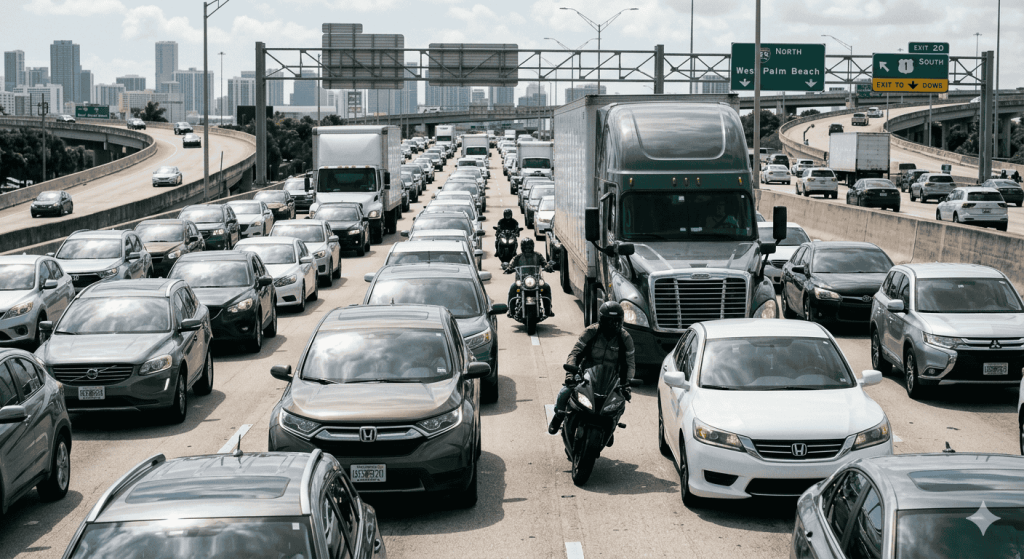
Florida consistently ranks among the worst states in the country for motorcycle fatalities. In Broward County, there are more than 700 motorcycle crashes reported annually — over 80% resulting in injuries to the rider. Fort Lauderdale’s dense traffic, high-speed corridors like I-95 and US-1, and year-round riding season create conditions where a single moment of driver inattention can permanently change your life.
Motorcyclists are not protected by steel frames, airbags, or crumple zones. When another driver fails to see you, cuts you off, or misjudges your speed, the injuries that follow — traumatic brain injury, spinal cord damage, fractured bones, road rash — are often catastrophic. And yet, insurers routinely treat motorcyclists as suspect from the moment a claim is filed.
Why Insurance Companies Defend Motorcycle Claims So Aggressively
Here is what most motorcyclists do not know going into a claim: the adjuster assigned to your file is working from a playbook designed to minimize your settlement.
Carlos D. Cabrera knows this playbook because he helped write it. Before becoming a Lawyer, Carlos worked as insurance defense counsel — evaluating claims, reviewing medical records, and developing the valuation arguments that insurers use to justify low offers.
How Insurance Companies Handle Motorcycle Claims — And Why Carlos D. Cabrera Is Different
Here is what most motorcyclists do not know going into a claim: the adjuster assigned to your file is working from a playbook designed to minimize your settlement. Common tactics include:
- Shifting blame onto the rider at the earliest opportunity
- Arguments that helmet use or non-use affected injury outcomes
- Claims the rider was speeding, weaving, or behaving recklessly
- A low initial offer before the full extent of injuries is known
- Pressure to settle before you have completed medical treatment
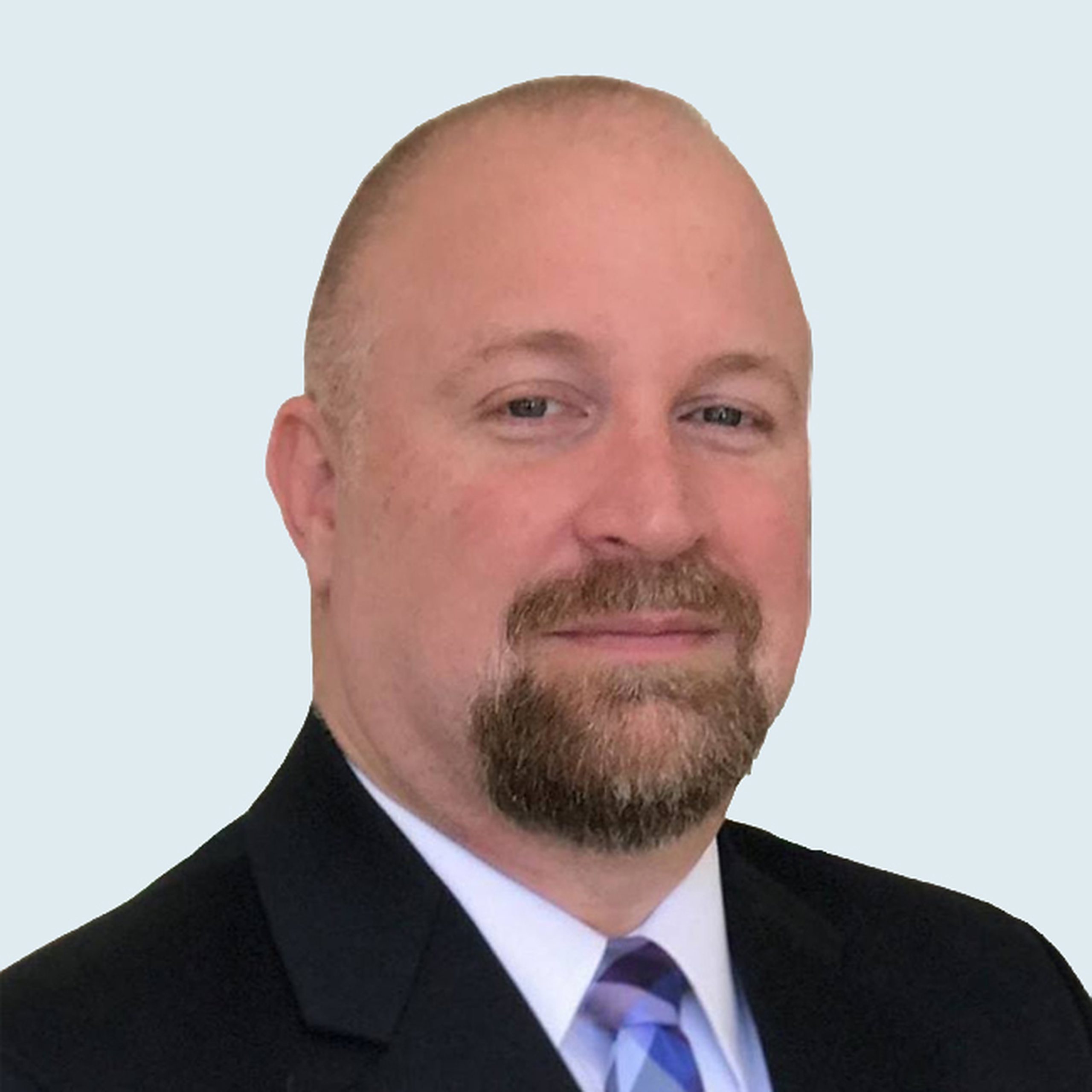
Carlos D. Cabrera spent years as insurance defense counsel before he became an attorney. He has sat on the other side of these cases. When he evaluates your motorcycle accident claim, he is evaluating it the way the insurance company will — and building the case that defeats their strategy. In one of our motor vehicle cases, an insurer offered $55,000 and cited prior injuries to minimize the claim. Our team proved those injuries were exacerbated by the crash and recovered nearly four times the initial offer.
The moment you retain Florida Advocates, all communication with the insurance company goes through us. You will not be recorded, pressured, or misled. We handle the insurance company while you focus on your recovery.
Common Causes of Motorcycle Accidents in Florida
Driver Negligence
Left-turn collisions
The leading cause of motorcycle accidents in Florida. A driver turns left in front of an oncoming motorcycle, failing to see the rider or misjudging their speed. These crashes are almost always the driver’s fault — but insurers still try to blame riders.
Failure to yield at intersections
Drivers run red lights, fail to yield, or make illegal turns — striking motorcycles who have the right of way.
Lane-change accidents
Drivers fail to check blind spots before changing lanes and strike a motorcycle traveling alongside them. Common on I-95 and other multi-lane roads.
Distracted driving
Texting, phone use, eating, and other distractions reduce a driver’s ability to see and react to motorcycles.
Rear-end collisions
Distracted or inattentive drivers strike motorcycles stopped at lights or in traffic. Even low-speed rear-end crashes can throw riders from their bikes.
Dooring incidents
Drivers or passengers open car doors into the path of oncoming motorcycles — common in Fort Lauderdale’s urban corridors and along Las Olas Boulevard.
Impaired driving
DUI crashes are particularly dangerous on A1A and late-night I-95 traffic.
Road Hazards
Potholes and uneven pavement
Conditions that cars can drive over safely can cause motorcycles to lose control.
Debris and gravel
Sand, gravel, and debris on roadways create traction hazards for motorcycles.
Construction zones
Uneven surfaces, lane shifts, and reduced visibility in construction zones — common on State Road 84 and other heavily-traveled routes.
Poor road maintenance
Municipalities may be liable for failing to maintain safe roads.
Dangerous Roads and Intersections for Motorcyclists in South Florida
Major Highways
Interstate 95
The most dangerous highway in Florida for all road users. High speeds, aggressive lane changes, heavy traffic, and distracted drivers make I-95 extremely dangerous for riders. The segment between I-595 and Marina Mile Boulevard — called “America’s Deadliest Mile” — sees frequent motorcycle crashes.
Interstate 595
Heavy commercial truck traffic traveling between I-95 and I-75. Complex interchanges and aggressive driving create unique hazards for motorcyclists.
US-1 (Federal Highway)
Frequent turning vehicles, commercial driveways, and drivers entering/exiting businesses create constant conflict points for riders traveling through.
Dangerous Local Roads
A1A
Narrow coastal road with heavy tourist traffic, pedestrians, and cyclists. Tourists unfamiliar with local roads often fail to check for motorcycles.
Las Olas Boulevard
Heavy pedestrian traffic, distracted drivers, and dooring hazards in entertainment districts.
State Road 84
Construction zones, uneven pavement, and debris create road hazard risks for motorcyclists.
Sunrise Boulevard
High-speed traffic and complex patterns, especially around the 2400 block and near I-95.
Oakland Park Boulevard
Heavy commuter traffic and frequent lane changes, especially at Powerline Road.
Broward Boulevard
Major east-west corridor with high-conflict intersections at Andrews Avenue and US-1.
High-Risk Intersections for Motorcyclists
- A1A & Las Olas Boulevard: 244 crashes reported (2023-2024) — highest in Fort Lauderdale
- Broward Boulevard & Andrews Avenue: Heavy commuter traffic, frequent pedestrian crossings
- Broward Boulevard & US-1: High volume, complex signals, rush-hour congestion
- Sunrise Boulevard & Federal Highway: Among the most dangerous in Broward County
- Cypress Creek Road & Powerline Road: 192 crashes reported, near I-95 ramps
- Oakland Park Boulevard & Powerline Road: Major commuter crossroads
If you were injured on any of these roads or anywhere else in South Florida, contact us for a free consultation.
Motorcycle Accident Injuries We Handle
Motorcycle crashes produce some of the most severe injuries we see. Without the protection of a vehicle frame, riders absorb the full force of impact.
Traumatic Brain Injury (TBI)
Even with a helmet, the forces of a motorcycle crash can cause concussions, contusions, and severe traumatic brain injuries. Symptoms may not appear immediately. TBI can result in cognitive impairment, personality changes, memory loss, and permanent disability.
Spinal Cord Injuries
The impact of a motorcycle crash can damage the spinal cord, resulting in:
- Herniated discs and nerve damage
- Partial paralysis (paraplegia)
- Complete paralysis (quadriplegia)
Spinal injuries often require lifetime medical care, adaptive equipment, and home modifications.
Road Rash and Degloving Injuries
When a rider slides across pavement, the friction strips away skin and tissue. Severe road rash can:
- Penetrate through skin to muscle and bone
- Require skin grafts and multiple surgeries
- Cause permanent scarring and disfigurement
- Lead to serious infection
Fractures and Broken Bones
- Fractured pelvis, femur, and tibia
- Broken wrists, arms, and shoulders
- Collarbone fractures
- Facial fractures and dental injuries
Some fractures require surgery with plates, screws, or rods. Some result in permanent limitation of movement.
Internal Organ Damage
The blunt force of impact can damage internal organs including the liver, spleen, and kidneys. Internal bleeding may not be immediately apparent and can be life-threatening.
Crush Injuries and Amputation
Severe trauma can result in crush injuries to hands and feet, or the loss of limbs — either at the scene or through surgical amputation afterward.
Psychological Injuries
- Post-traumatic stress disorder (PTSD)
- Anxiety and depression
- Fear of riding
- Sleep disturbances
Wrongful Death
The most devastating outcome. When a rider is killed, surviving family members face not only grief but also financial hardship from lost income and support.
Learn more about Wrongful Death Claims →
Case Results
$2,500,000 — Motorcycle vs. Ambulance
| Case Overview | Details |
|---|---|
| The Situation | Our client was riding behind an ambulance when it stopped suddenly without warning. He collided with the ambulance and was thrown onto the windshield of another vehicle. Police cited him at the scene for following too closely. |
| Insurance Company’s Position | “Your client was cited at the scene. He was following too closely. He caused this accident. Claim denied.” |
| Our Investigation | We did not accept the police report as the final word. Our legal team: • Gathered testimony from multiple witnesses who saw the ambulance stop without warning. • Obtained the ambulance’s GPS and dispatch records. • Consulted accident reconstruction experts. • Documented the ambulance driver’s failure to signal or brake appropriately. • Proved the ambulance driver—not our client—was at fault. |
| The Result | $2,500,000 recovered despite our client being cited at the scene. |
$190,000 — Motor Vehicle Accident with Pre-Existing Condition
| Case Overview | Details |
|---|---|
| The Situation | Our client was injured in a motor vehicle collision that aggravated a pre-existing back condition. |
| Insurance Company’s Position | The insurance adjuster reviewed the client’s medical records, identified prior treatment for back pain, and offered $55,000, arguing that the crash did not cause the current symptoms. |
| Our Approach | We documented exactly how the collision transformed a previously manageable condition into a disabling injury, demonstrating that the crash significantly worsened our client’s health and damages. |
| The Result | $190,000 recovered—nearly four times the insurance company’s initial offer. |
Past results do not guarantee future outcomes. Every case is evaluated on its individual facts.
Florida Law and Your Motorcycle Accident Claim
No PIP Coverage for Motorcycles
Florida’s PIP (Personal Injury Protection) no-fault coverage does NOT apply to motorcycles. This is a critical difference from car accidents.
What this means for you:
- You cannot recover medical expenses through your own PIP policy after a motorcycle crash
- You must pursue the at-fault driver’s liability insurance directly
- You must prove fault — PIP’s no-fault coverage does not apply
- If the at-fault driver is uninsured, you must rely on your own UM/UIM coverage
This makes early evidence preservation and investigation critical in motorcycle cases.
Modified Comparative Negligence (Effective March 2023)
Florida shifted to a modified Comparative Negligence system in March 2023. If you are found more than 50% at fault for an accident, you cannot recover any damages. If partially at fault below 50%, your recovery is reduced by your percentage. This is why the work done to counter fault arguments — as we did in the ambulance case — is critical to your recovery.
- If you are found partially at fault below 50%, your recovery is reduced by your percentage of fault
- If you are found more than 50% at fault, you cannot recover any damages
This is why the work done to counter fault arguments — as we did in the ambulance case where our client was cited at the scene — is critical to your recovery. Insurers aggressively use comparative fault arguments in motorcycle cases because of bias against riders.
Building the evidentiary record that defeats or minimizes your fault percentage is a core part of what we do from day one.
Florida’s Motorcycle Helmet Law
Riders over 21 may ride without a helmet if they carry at least $10,000 in injury insurance. The absence of a helmet does not bar your claim, but insurers routinely attempt to use it to argue reduced damages. We anticipate and counter this argument.
However, insurance companies use helmet non-use against riders:
- They argue lack of helmet contributed to head injuries
- They claim comparative fault based on helmet choice
- They reduce damage awards citing “failure to mitigate”
We anticipate this argument in every case involving a rider who was not wearing a helmet. We counter it with medical evidence showing the actual cause of your injuries and expert testimony where necessary.
Wearing a helmet is the safest choice — and removes this argument from the table.
No-Fault Insurance Does Not Apply to Motorcyclists
Florida’s PIP (personal injury protection) law covers car accident victims — not motorcyclists. You must pursue the at-fault driver’s liability coverage, which requires proving fault. This makes legal representation essential from the earliest stages of the claim.
Statute of Limitations — Two Years
Two years from the date of the accident to file a personal injury lawsuit. Missing this deadline permanently eliminates your right to compensation.
You have two years from the accident date to file a personal injury lawsuit in Florida. Missing this deadline permanently eliminates your right to compensation. Surveillance footage, witness memories, and physical evidence all deteriorate with time. Contact us immediately.
What to Do After a Motorcycle Accident in Florida
At the Scene
- Get to safety if you can move without worsening injuries
- Call 911 and obtain an official accident report — do not leave the scene
- Do not remove your helmet unless necessary — let paramedics assess you
- Accept emergency medical treatment — adrenaline masks injury and symptoms may not appear for hours or days
- Photograph everything:
- Road conditions and vehicle positions
- Skid marks and debris
- Damage to your motorcycle from multiple angles
- Damage to other vehicles
- Your injuries (visible injuries)
- Your helmet and gear (damage visible)
- Traffic signals and signs
- Weather conditions
- Get witness contact information — names and phone numbers
- Do NOT discuss fault at the scene — and do not apologize
Preserve Evidence
- Preserve your motorcycle — Do NOT authorize repairs until it has been fully documented
- Preserve your helmet and gear — Do NOT repair, clean, or discard
- Your helmet shows impact evidence
- Gear shows slide distance and road contact
- This is critical evidence for your case
- Keep all medical records and bills
Protect Your Claim
- Follow up with a doctor as soon as possible — even if you feel fine
- Do NOT give recorded statements to any insurance company
- Do NOT sign anything from an insurance adjuster
- Do NOT accept a quick settlement offer
- Do NOT post on social media about the accident
- Contact Florida Advocates for a free consultation
Two years from the date of the accident to file a personal injury lawsuit. Missing this deadline permanently eliminates your right to compensation.
Preserve your motorcycle, helmet, and gear. Do not authorize repairs, do not clean or discard the helmet, do not throw away your gear. Your motorcycle and gear are critical evidence — accident reconstruction experts use damage patterns and slide marks to prove what really happened.
Damages You Can Recover
If you were injured in a motorcycle accident in Florida, you may be entitled to compensation for:
Economic Damages
- Medical expenses — Emergency care, trauma surgery, hospitalization, rehabilitation, physical therapy, medications, medical equipment, skin grafts for road rash, future surgeries and treatment
- Lost wages — Time missed from work during recovery
- Lost earning capacity — Permanent reduction in your ability to work due to injury
- Property damage — Motorcycle repair or replacement, helmet, gear, personal belongings
- Home modifications — If spinal injury requires wheelchair accessibility
- Adaptive equipment — Prosthetics, mobility devices, modified vehicles
Non-Economic Damages
- Pain and suffering — Physical pain from injuries and recovery
- Emotional distress — Anxiety, depression, PTSD, fear of riding
- Scarring and disfigurement — Permanent road rash scars, amputation
- Loss of enjoyment of life — Inability to ride, participate in activities you enjoyed
- Loss of consortium — Impact on your relationship with your spouse
Wrongful Death Damages
If a loved one was killed in a motorcycle accident:
- Funeral and burial expenses
- Lost financial support
- Loss of companionship, guidance, and protection
- Mental pain and suffering of survivors
Learn more about Wrongful Death Claims →
Why Carlos D. Cabrera for Your Florida Motorcycle Case
Carlos D. Cabrera leads the personal injury division at Florida Advocates. Before becoming a Lawyer, Carlos worked as insurance defense counsel, defending insurance companies against bodily injury claims. He was selected to handle his firm’s largest and most complex insurance defense matters, managing cases under specialized handling procedures. He was then recruited by a personal injury firm — which is where he decided to switch sides and pursue his law degree to represent injury victims.
Determined to take on that responsibility himself, Carlos made significant personal sacrifices to pursue a new path from insurance defense to plaintiff’s advocacy. That inside knowledge of how insurance companies evaluate, delay, and undervalue claims is what sets him apart from Lawyers who have only ever worked on one side of a case.
Carlos earned his J.D. from St. Thomas University College of Law (2000), where he served as Managing Editor of the St. Thomas Law Review. He is admitted to all three U.S. District Courts in Florida — Southern, Middle, and Northern Districts. Carlos is a member of the Million Dollar Advocates Forum and Multi-Million Dollar Advocates Forum and has more than 24 years of insurance litigation experience.
Education
- J.D. — St. Thomas University College of Law (2000)
- Managing Editor, St. Thomas Law Review
- B.A. English — Florida International University (1994)
Bar Admissions
- The Florida Bar
- U.S. District Court, Southern District of Florida
- U.S. District Court, Middle District of Florida
- U.S. District Court, Northern District of Florida
Carlos’s federal court admissions mean he can handle complex cases that cross state lines or involve federal questions — not just state court claims.
Credentials & Recognitions
- Million Dollar Advocates Forum Member
- Multi-Million Dollar Advocates Forum Member
- Florida Legal Elite Recognition
- Lead Counsel Verified (Appellate, since 2015)
- Former Insurance Defense Counsel
Learn more about Carlos D. Cabrera →
Insurance Insider Who Advocates for Riders
Most motorcycle accident Lawyers have only ever worked one side of a claim. Carlos D. Cabrera worked on both sides.
Before law school, Carlos worked as insurance defense counsel. He:
- Evaluated accident claims — including motorcycle crashes
- Reviewed medical records to identify pre-existing conditions
- Developed the valuation arguments insurers use to justify low offers
- Was selected to handle his firm’s largest and most complex insurance defense matters, managing cases under specialized handling procedures
Then he went to work for a personal injury firm — which is where he decided to switch sides and pursue his law degree to represent injury victims.
When Carlos takes your motorcycle case, he is not guessing what the insurance company is going to argue. He already knows. “Hard to see.” “Assumed the risk.” “Wasn’t wearing a helmet.” “Was probably speeding.” He has heard them all — because he used to make them.
Now he defeats them. The $2.5 million recovery for a rider who was cited at the scene proves it.
Frequently Asked Questions — Florida Motorcycle Accidents
Can I recover compensation if I was partially at fault?
Yes. Under Florida’s modified comparative negligence rule, you can recover as long as you are not more than 50% at fault. Your recovery is reduced by your percentage of fault. Countering fault arguments is exactly where an experienced attorney makes the difference.
What if I was not wearing a helmet?
You can still file a claim. Florida does not require a helmet for riders over 21 who carry the required insurance. Insurers may raise the helmet issue to argue reduced damages — we are prepared to counter this argument from the start.
What does it cost to hire a Florida Advocates motorcycle attorney?
Nothing unless we recover for you. We work on a contingency fee basis and advance all costs. You pay nothing unless we win your case.
Does Florida PIP cover motorcycle accidents?
No. Florida’s Personal Injury Protection (PIP) no-fault coverage does NOT apply to motorcycles. After a motorcycle crash, you must pursue the at-fault driver’s liability insurance directly, or rely on your own uninsured/underinsured motorist (UM/UIM) coverage if the at-fault driver has no insurance or insufficient insurance. This makes early evidence preservation and investigation critical in motorcycle cases.
Can I still recover if I was not wearing a helmet?
Yes. Florida does not require helmets for riders over 21 who carry at least $10,000 in medical insurance coverage. However, insurance companies will use helmet non-use against you, arguing it contributed to your injuries. We counter these arguments with medical evidence showing the actual cause of your injuries and expert testimony when needed. Even riders without helmets recover compensation.
What if I was cited at the scene of the accident?
A citation at the scene does not end your case. We recovered $2.5 million for a client who was cited at the scene by gathering witness testimony, obtaining vehicle GPS and dispatch records, consulting accident reconstruction experts, and proving the other driver was actually at fault. Police officers make initial determinations based on limited information at the scene. Civil liability is determined by the full evidence, not the citation.
What if the at-fault driver was uninsured?
If the at-fault driver has no insurance or insufficient insurance to cover your damages, your own uninsured/underinsured motorist (UM/UIM) coverage may apply. UM/UIM coverage on a motorcycle policy is critical because PIP does not apply. We also investigate other potential sources of recovery, including employer liability if the at-fault driver was working, dram shop claims if alcohol was involved, and product liability if a vehicle component contributed.
How long do I have to file a motorcycle accident claim in Florida?
Two years from the date of the accident under Florida’s modified statute of limitations. Wrongful death claims must be filed within two years of the date of death. Special deadlines apply to government entity defendants. Surveillance footage and witness recollections deteriorate quickly, so contact an Lawyer as soon as possible after any motorcycle crash.
What if I was partially at fault?
Florida’s modified comparative negligence rule means you can still recover compensation as long as you were not more than 50% at fault. Your recovery is reduced by your percentage of fault. Insurers aggressively assign fault to motorcyclists because of bias against riders. Building the evidence that defeats or minimizes your fault percentage is a core part of how we build motorcycle accident cases.
Should I preserve my motorcycle and helmet after a crash?
Absolutely. Do not authorize repairs to your motorcycle, do not clean or discard your helmet, and do not throw away your gear. Your helmet shows impact evidence. Your gear shows slide distance and road contact. Your motorcycle shows damage patterns that accident reconstruction experts use to prove what actually happened. This physical evidence is often decisive in motorcycle cases.
What does it cost to hire Florida Advocates for a motorcycle accident case?
Nothing unless we recover for you. We work on a contingency fee basis and advance all costs (filing fees, expert witnesses, accident reconstruction, medical records). You pay nothing unless we win your case. Your initial consultation is free and confidential.
Florida Medical and Emergency Resources
If you are injured in a motorcycle accident in Florida, these are primary trauma centers in the South Florida region:
Level I Trauma Centers — Broward County
Broward Health Medical Center
(Level I Adult & Pediatric) 1600 S Andrews Avenue, Fort Lauderdale, FL 33316
Phone: (954) 355-4400
Website
Memorial Regional Hospital
(Level I Trauma) 3501 Johnson Street, Hollywood, FL 33021
Phone: (954) 987-2000
Joe DiMaggio Children’s Hospital
(Level I Pediatric) 1005 Joe DiMaggio Drive, Hollywood, FL 33021
Phone: (954) 265-5324
Level I Trauma Centers — Miami-Dade County
Jackson Memorial Hospital / Ryder Trauma Center
(Level I Adult) 1611 NW 12th Avenue, Miami, FL 33136
Phone: (305) 585-6901
Level I Trauma Centers — Tampa Bay
Tampa General Hospital
(Level I Adult) 1 Tampa General Circle, Tampa, FL 33606
Phone: (813) 844-7000
Law Enforcement
Miami-Dade Police Department
Phone: (305) 476-4567
Florida Highway Patrol (Statewide)
Phone: (850) 847-2500
Broward County Sheriff’s Office
Phone: (954) 831-8900
Why Choose Florida Advocates for Your Motorcycle Accident Case
You may have seen billboards, TV commercials, and online ads promising fast settlements. Many of these are “settlement mills” — high-volume firms that push for quick settlements rather than maximum recovery. Motorcycle cases are particularly poorly served by this approach because the bias riders face requires methodical evidence-building to overcome.
At Florida Advocates, we take a different approach:
- Direct Lawyer involvement — Carlos D. Cabrera personally oversees your case
- Insurance insider knowledge — we know the playbook because Carlos helped write it
- Immediate evidence preservation — preservation letters and motorcycle/gear documentation begin the same day you retain us
- Federal court experience — we can litigate at any level
- Accident reconstruction resources — we advance all expert costs
- No rushed settlements — we build cases for maximum value, not quick turnover
- Proven results against bias — $2.5M recovered for a rider cited at the scene
You deserve more than a billboard. You deserve an advocate who understands the bias riders face and knows exactly how to defeat it.
No Fee Unless We Win
We work on a contingency fee basis. That means:
- Free consultation — No cost to speak with us about your case
- No upfront fees — We advance all case costs (filing fees, expert witnesses, medical records, accident reconstruction)
- No Lawyer fees unless we recover for you — If we don’t win, you don’t pay
You will never receive a bill from us while your case is active. We only get paid when you do.
About Florida Advocates
Florida Advocates is a personal injury law firm headquartered in Dania Beach, Florida — in the heart of Broward County. We represent motorcycle accident victims throughout Fort Lauderdale, Broward County, and all of Florida.
Office Locations:
Dania Beach (Broward County) — Headquarters
45 E Sheridan Street Dania Beach, FL 33004
North Miami (Miami-Dade County)
13499 Biscayne Blvd #107 North Miami, FL 33181
Tampa (Hillsborough County)
238 E Davis Blvd #210 Tampa, FL 33606
Phone: 754-290-3803
Email: info@fladvocates.com
Hours: Monday – Friday: 9:00 AM – 5:00 PM
Available by phone 24/7 for emergencies
Statewide Service — Serving Motorcycle Accident Victims Throughout Florida
We handle motorcycle accident cases throughout Florida, including:
- Fort Lauderdale
- Dania Beach — Office Location
- Hollywood
- Pembroke Pines
- Coral Springs
- Plantation
- Hallandale Beach
- Miramar
- Weston
- Pompano Beach
- Boca Raton
- Miami
- Miami Beach
- Hialeah
- North Miami
- Tampa
- Sarasota
- Orlando
If you were injured in a motorcycle accident anywhere in Florida, we can help.
Contact a Florida Motorcycle Accident Lawyer
If you were injured in a motorcycle accident anywhere in Florida, contact Florida Advocates today. Time matters — surveillance footage, witness recollections, and physical evidence all deteriorate quickly. Your motorcycle, helmet, and gear must be preserved as evidence. Call now to protect your case.
Call: 754-290-3803
Email: info@fladvocates.com
Call us for a free consultation. You pay nothing unless we recover for you. After all, isn’t that what family would do?
Related Practice Areas
If your accident involved:
A car
A commercial truck
A death in the family
A defective motorcycle or helmet
A denied insurance claim
Contact Us
Fill out the contact form or call us at 754-290-3803 to schedule your free consultation. Free Consultation
  Available 24/7
  No Fees Unless You Win