

Your Story Matters. Your Family Matters. Your Results Matter.


Awards and recognitions listed are not indicative of future results. Selection criteria vary by organization.
Florida Truck Accident Lawyer | Broward County & South Florida
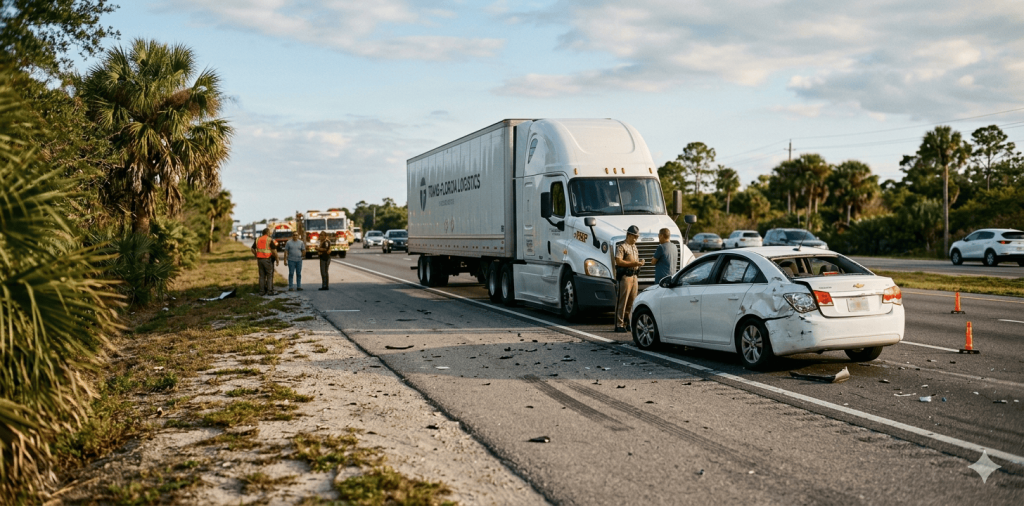
Commercial Truck Cases Move Fast on Evidence and Slow on Settlement. We Move Fast Either Way.
Florida Advocates represents victims of commercial truck and 18-wheeler accidents throughout Broward County, Fort Lauderdale, and South Florida. When you have been injured by a commercial truck on I-95, I-595, the Florida Turnpike, or any Broward County roadway, you face an opponent with very different resources and very different defenses than an ordinary driver — and you need an Lawyer who knows how to dismantle them.
Carlos D. Cabrera spent years defending insurance companies before becoming a trial Lawyer. He knows from the inside exactly how trucking companies and their insurers defend these cases — and he begins building the counter-evidence the same day you retain him. Including spoliation letters, ECM preservation demands, and driver log requests within hours of being engaged.
A Finger Amputation, Disputed Liability, and a Defendant Who Said “Not Our Employee”
| Case Overview | Details |
|---|---|
| The Situation | Our client was assisting a FedEx employee when his finger was amputated during the course of that assistance. |
| Defendant’s Position | “Your client wasn’t a FedEx employee. He had no business assisting our driver. We have no liability for his injuries.” |
| Our Investigation | We challenged that position by analyzing the legal principles of vicarious liability and the FedEx driver’s actions while performing job duties. We documented the driver’s conduct, established how Florida law applied to the circumstances, and demonstrated why FedEx was legally responsible for the injuries—even though our client was not a FedEx employee. |
| The Result | $100,000 recovered despite disputed liability and the fact that the injured party was not a FedEx employee. |
This is exactly the kind of case commercial trucking and delivery defendants count on never paying out. The “not our employee” defense is one of the most common — and one of the most defeatable — positions in commercial vehicle litigation. The label the company puts on the relationship is not what determines liability. Florida law is.
Past results do not guarantee future outcomes. Every case is evaluated on its individual facts.
Florida Truck Accident Statistics
Florida is one of the most dangerous states in the country for commercial truck crashes. According to the Florida Department of Highway Safety and Motor Vehicles (FLHSMV) and Federal Motor Carrier Safety Administration (FMCSA) data:
| Statistic | 2023 Data |
|---|---|
| Florida crashes involving large trucks | 32,000+ |
| Florida fatalities involving large trucks | 350+ |
| Broward County truck-involved crashes | 2,000+ |
| Average cost of a fatal large-truck crash | $7+ million |
The reason for the high fatality rates: physics. A loaded 18-wheeler weighs 80,000 pounds. A passenger vehicle weighs roughly 4,000 pounds. In a collision, the energy transfer is 20-to-1. What is a moderate impact for the truck is often catastrophic for the occupants of the passenger vehicle.
Beyond the size disparity, commercial truck crashes are made worse by:
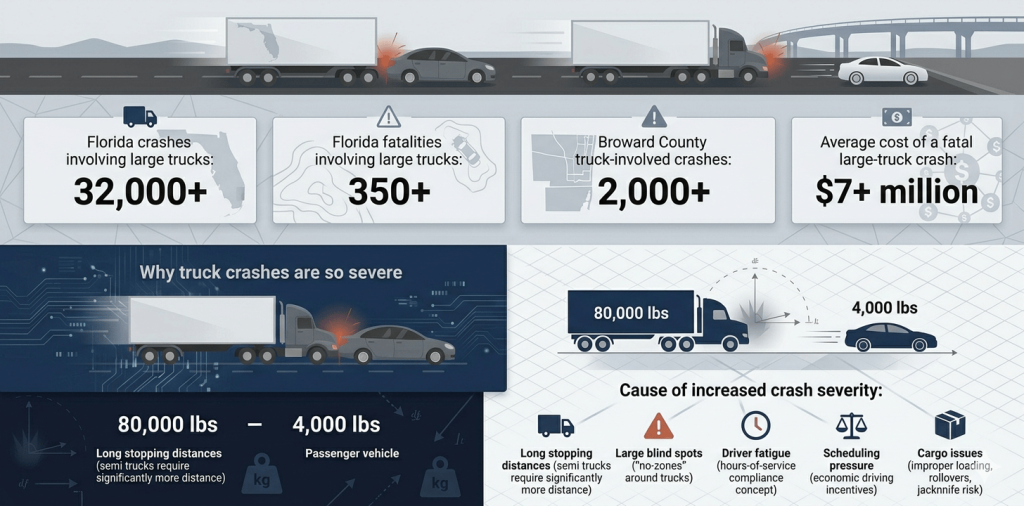
- Long stopping distances — a fully loaded semi requires 40% more stopping distance than a passenger vehicle
- Larger blind spots — the “no-zones” around a commercial truck are far larger than most drivers realize
- Driver fatigue — federal hours of service rules exist because tired truckers cause crashes
- Aggressive scheduling pressure — drivers paid by the mile have economic incentives to violate safety rules
- Cargo issues — improperly loaded or unsecured cargo can cause rollovers, jackknifes, and load-shift crashes
Why Carlos D. Cabrera Handles Truck Accident Cases Differently

Most personal injury Lawyers have only ever worked one side of a claim. Carlos D. Cabrera worked on both sides before he ever set foot in a courtroom as a trial Lawyer.
Before law school, Carlos worked as insurance defense counsel. He evaluated claims, reviewed evidence, and developed the valuation arguments that insurers use to justify low offers — including commercial vehicle claims. He was selected to handle his firm’s largest and most complex insurance defense matters, managing cases under specialized handling procedures. He was then recruited by a personal injury firm — which is where he decided to switch sides and represent injury victims himself.
When Carlos takes on your truck accident case, he is not guessing what the trucking company and its insurers will argue. He already knows. “Independent contractor.” “Not our employee.” “The other driver caused it.” “Your client cut him off.” He has heard them all — because he used to make them.
Now he defeats them. The $100,000 recovery for a finger amputation in a disputed-liability FedEx case proves it.
Learn more about Carlos D. Cabrera →
Why Truck Accident Cases Are Different — And Why That Matters to Your Recovery
Truck accident cases are not just bigger car accident cases. They are governed by a different body of law, involve more potential defendants, and require evidence that does not exist in passenger vehicle crashes. Most importantly, they involve evidence that disappears quickly if you do not act fast.
Federal Regulations Apply
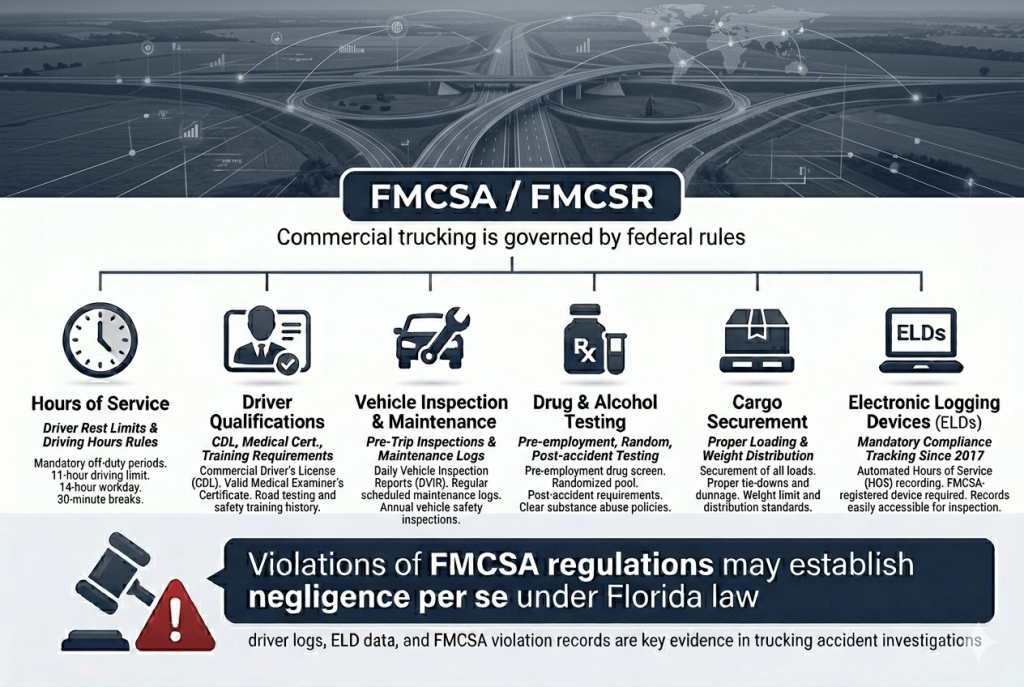
Commercial trucking is regulated by the Federal Motor Carrier Safety Administration (FMCSA) under the Federal Motor Carrier Safety Regulations (FMCSR). These federal rules govern:
- Hours of service — how many hours a driver can drive without rest
- Driver qualifications — CDL requirements, medical certifications, training
- Vehicle inspection and maintenance — pre-trip inspection requirements, maintenance records
- Drug and alcohol testing — pre-employment, random, post-accident
- Cargo securement — how cargo must be loaded, secured, and weight-distributed
- Electronic logging devices (ELDs) — mandatory for most commercial trucks since 2017
Violations of these federal rules can establish negligence per se under Florida law — meaning the violation itself is sufficient to prove the trucking company or driver was negligent. We obtain driver logs, ELD data, and FMCSA violation records as part of our standard investigation.
Multiple Liable Parties
Unlike a typical car accident with one at-fault driver, a commercial truck case typically involves three to seven potentially liable parties:
- The truck driver — for negligent driving, fatigue, distraction, impairment, or training violations
- The trucking company — vicariously liable for the driver’s negligence; directly liable for negligent hiring, supervision, training, or retention
- The cargo loader / shipper — liable if improper loading or unsecured cargo caused or worsened the crash
- The truck manufacturer — products liability if a defective part contributed (brake failure, steering defect, tire blowout)
- The component manufacturer — products liability for defective tires, brakes, or other parts
- The maintenance provider — liable if inadequate or negligent maintenance contributed
- The broker or shipper — liable in some circumstances for negligent selection of an unsafe carrier
Identifying every liable party means identifying every available insurance policy. Trucking companies are required to carry minimum federal liability coverage of $750,000 for general freight, $1,000,000 for hazardous materials, and $5,000,000 for certain hazardous cargo. Many carry far more. Multiple defendants often means stacked policies — and significantly larger total recoveries.
Critical Evidence Disappears Fast
This is the single most important difference between truck accidents and car accidents. Trucking evidence has a short shelf life:
- Black box / ECM data — can be overwritten when the truck returns to service, sometimes within hours
- Driver logs and ELD data — federal regulations require only 6 months of retention
- Pre-trip inspection reports — typically retained 12 months or less
- Drug and alcohol test results — retention periods vary
- Maintenance records — typically retained 12-18 months
- Surveillance footage — most highway and business cameras overwrite within 30 days
- Witness recollections — degrade quickly
THE FIRST 72 HOURS MATTER MOST
We send spoliation preservation letters to trucking companies the same day you retain us — demanding preservation of ECM data, driver logs, drug and alcohol tests, maintenance records, and any other relevant evidence. The longer you wait, the more evidence is gone.
Common Causes of Truck Accidents in Florida
Driver Fatigue
Federal hours of service rules limit how long a commercial driver can drive without rest. Drivers paid by the mile face economic pressure to exceed these limits. Driver fatigue is a leading cause of fatal truck crashes nationwide.
Distracted Driving
Texting, phone use, dispatcher communication, GPS interaction, and eating while driving. Federal rules prohibit handheld phone use by commercial drivers. Phone records and ELD data often reveal distracted driving.
Impaired Driving
DUI by commercial drivers is rare but devastating. Federal rules require post-accident drug and alcohol testing. We obtain those test results as part of our investigation.
Speeding and Aggressive Driving
Commercial trucks at highway speed take significantly longer to stop than passenger vehicles. Speeding is particularly dangerous when combined with heavy cargo, downhill grades, or wet pavement.
Improper Cargo Loading
Overloaded trucks, unsecured cargo, and improperly distributed weight can cause rollovers, jackknifes, brake failures, and load-shift crashes.
Inadequate Driver Training
Many trucking companies provide minimal training before putting new drivers behind the wheel of an 80,000-pound vehicle. Negligent training claims target the company directly.
Negligent Hiring and Retention
Trucking companies that hire drivers with poor driving records, prior DUI convictions, or expired CDLs can be held directly liable for negligent hiring. Companies that fail to terminate drivers after repeated safety violations can be liable for negligent retention.
Defective Equipment
Brake failures, tire blowouts, steering defects, and other equipment failures cause catastrophic crashes. Products liability claims against the manufacturer or component supplier add additional layers of recovery.
Inadequate Maintenance
Trucks are required to undergo regular inspections and maintenance. Inadequate maintenance — bald tires, worn brakes, broken lights — can establish liability for the trucking company or maintenance provider.
Unsafe Routing
Trucking companies that route drivers through areas where commercial trucks are prohibited, or assign routes that require unsafe maneuvers, can face direct liability.
Types of Commercial Truck Cases We Handle

18-Wheelers and Semi-Trucks
The largest commercial vehicles on Florida highways. Crashes involving fully loaded tractor-trailers produce some of the most severe injuries we see.
Delivery Vehicles
FedEx, UPS, Amazon, and other delivery vehicles operate in Broward County by the thousands. Liability questions involve employment status, contractor relationships, and parent company supervision.
Dump Trucks
Construction-related dump truck accidents involve loose cargo, blind spots, and operator training issues.
Garbage Trucks
Frequent stops, blind spots, and pedestrian/cyclist conflicts create unique hazards.
Tow Trucks
Roadside operations create high-risk conflicts with passing vehicles. Improper towing practices can also cause secondary crashes.
Tanker Trucks
Hazardous materials, fuel tankers, and chemical transport trucks face heightened federal scrutiny — and create catastrophic risks when crashes occur.
Box Trucks and Commercial Vans
Smaller commercial vehicles still operate under FMCSA rules in many circumstances, particularly when crossing state lines or carrying commercial cargo.
Construction and Utility Trucks
Bucket trucks, cement mixers, and utility vehicles operate under unique safety standards and often near pedestrian and worker traffic.
Catastrophic Injuries from Truck Crashes
Because of the size disparity between commercial trucks and passenger vehicles, truck crash injuries are often catastrophic and life-altering:
Traumatic Brain Injury (TBI)
Severe brain injuries are common in truck crashes. Symptoms can include cognitive impairment, personality changes, memory loss, and permanent disability.
Spinal Cord Injuries
Herniated discs, nerve damage, partial paralysis, and complete paralysis. Spinal injuries from truck crashes often require lifetime medical care, adaptive equipment, and home modifications.
Amputations
Crush injuries can result in amputations — at the scene or surgically afterward. The $100,000 recovery in our FedEx case involved a finger amputation while assisting a delivery employee.
Severe Burns
Fuel tank ruptures, fires, and rollover crashes can cause severe burns requiring multiple surgeries and skin grafts.
Multiple Fractures
Broken pelvis, femur, ribs, sternum, wrists, arms — complex fractures often requiring surgery with plates, screws, or rods, and resulting in permanent limitation of movement.
Internal Organ Damage
The blunt force of a truck collision can damage organs including the liver, spleen, kidneys, and intestines. Internal bleeding may not be immediately apparent.
Wrongful Death
The most devastating outcome. The size and weight differential between trucks and passenger vehicles means truck crashes produce a disproportionate share of fatal injury cases.
Learn more about wrongful death claims →
Psychological Injuries
Post-traumatic stress disorder, anxiety, depression, and fear of driving — particularly fear of driving near commercial trucks — are real injuries with real economic consequences.
Dangerous Roads for Commercial Truck Crashes in South Florida
Interstate 95
The most dangerous highway in Florida for all vehicle types. The stretch between I-595 and Marina Mile Boulevard — “America’s Deadliest Mile” — sees frequent commercial truck crashes.
Interstate 595
Heavy commercial truck traffic between I-95 and I-75. Complex interchanges and aggressive driving create unique hazards.
Interstate 75 (Alligator Alley)
Major east-west commercial corridor. Long stretches of monotonous highway contribute to driver fatigue.
Florida’s Turnpike
High-speed commercial truck traffic with heavy passenger vehicle volume. Wet pavement and afternoon storms create rollover and jackknife conditions.
US-27
Major commercial route from South Florida to the Lake Okeechobee region. Two-lane sections with passing zones create head-on collision risks.
State Road 84
Commercial truck access road with construction zones and uneven pavement.
Major Broward County Distribution Corridors
- Powerline Road — major commercial trucking corridor with frequent loading/unloading operations
- State Road 7 / US-441 — high-speed commercial traffic mixed with frequent business entrances
- NW 12th Avenue — heavy truck traffic to and from Port Everglades
- Eller Drive / Port Everglades — port traffic with frequent commercial vehicle movements
Florida Truck Accident Law — What You Need to Know
Modified Comparative Negligence
Florida follows a modified comparative negligence rule under Florida Statute § 768.81, revised in March 2023:
- If you are found partially at fault below 50%, your recovery is reduced by your percentage of fault
- If you are found more than 50% at fault, you cannot recover any damages
Trucking companies aggressively assign fault to passenger vehicle drivers — often without basis. Building the evidence that defeats or minimizes your fault percentage is a core part of how we build truck accident cases.
Statute of Limitations — Two Years
Two years from the date of the accident to file a personal injury lawsuit. But evidence preservation deadlines run faster — federal regulations require only 6 months of driver log retention. Contact an Lawyer within days, not weeks.
Special deadlines apply when:
- A government entity is the defendant (state-owned trucks, garbage trucks, snow plows) — pre-suit notice within 3 years under Fla. Stat. § 768.28, with damage caps applicable
- The crash caused a death — wrongful death claim must be filed within 2 years of the date of death
- A defective truck component contributed — products liability claim has a 4-year statute of limitations
Spoliation of Evidence
Florida law recognizes a duty to preserve evidence relevant to anticipated litigation. When a trucking company knows or should know that a crash may result in litigation, they have a legal obligation to preserve relevant records. When they don’t, sanctions can include adverse jury instructions, exclusion of evidence, or default judgment.
We send formal spoliation preservation letters to trucking companies, their insurers, and any other potential defendants the same day we are retained — putting them on notice and creating the legal foundation for spoliation sanctions if evidence is destroyed.
What to Do After a Truck Accident in Florida
At the Scene
- Call 911 immediately — request medical assistance and law enforcement (Florida Highway Patrol typically investigates commercial truck crashes)
- Do not move the vehicles unless required for safety — preserve the crash scene
- Photograph everything:
- The truck — including DOT number, company name, and license plate
- Trailer information — DOT number on the trailer (often different from the truck)
- Vehicle positions and damage from multiple angles
- Skid marks and debris field (often extends much farther than in car crashes)
- Traffic signals, signs, and weather conditions
- The truck driver and yourself (visible injuries)
- Get witness contact information — names and phone numbers
- Get the truck driver’s information — driver’s license, CDL, insurance card, employer name, and dispatch contact
- Accept emergency medical treatment — adrenaline masks injury and symptoms may not appear for hours
- Do NOT discuss fault at the scene — and do not apologize
Within 24-72 Hours
- See a doctor as soon as possible — even if injuries seem minor (preserves PIP benefits for related vehicle damage)
- Contact an Lawyer — truck accident evidence is the most time-sensitive of any personal injury case. Do not wait days or weeks.
- Do NOT give recorded statements to the trucking company’s insurance representative
- Do NOT accept a quick settlement offer — trucking companies often offer fast lowball settlements specifically to avoid the discovery process
Protect Your Claim
- Preserve your vehicle — do not authorize repairs until it has been documented
- Keep all medical records, bills, and receipts
- Document all symptoms in a daily journal
- Do NOT post on social media about the accident
- Forward all trucking company / insurance correspondence to your Lawyer unread
TIME IS THE ENEMY
The trucking company’s accident response team is at the scene within hours — gathering evidence to defend the company. You need an Lawyer engaged within days to balance the field and preserve evidence before it is lost or destroyed.
Damages You Can Pursue in a Florida Truck Accident Case
Economic Damages
- Medical expenses — emergency care, trauma surgery, hospitalization, rehabilitation, future treatment, lifetime care for catastrophic injuries
- Lost wages — past and future
- Reduced earning capacity from permanent disability
- Property damage — vehicle repair or replacement, personal belongings
- Home modifications — wheelchair accessibility, adaptive bathroom, ramps
- Adaptive equipment — prosthetics, mobility devices, modified vehicles
Non-Economic Damages
- Pain and suffering — physical pain from injuries and recovery
- Emotional distress — anxiety, depression, PTSD, fear of driving
- Permanent disability or disfigurement — including amputation
- Loss of enjoyment of life — inability to participate in activities you previously enjoyed
- Loss of consortium — impact on your relationship with your spouse
Wrongful Death Damages
If a loved one was killed in a truck crash:
- Funeral and burial expenses
- Lost financial support
- Loss of companionship, guidance, and protection
- Mental pain and suffering of survivors
Learn more about wrongful death damages →
Punitive Damages
Available in cases involving egregious conduct under Florida Statute § 768.72. Truck cases are more likely to support punitive damages than typical car accident cases — particularly when:
- The driver was impaired
- Hours of service rules were knowingly violated
- The trucking company knew the driver was unsafe and continued to dispatch him
- Maintenance records were falsified
- Drug and alcohol testing was not performed when required
Frequently Asked Questions — Florida Truck Accidents
How are truck accident cases different from car accident cases in Florida?
Truck accident cases are governed by federal regulations under the Federal Motor Carrier Safety Administration (FMCSA), in addition to Florida state law. They typically involve multiple liable parties including the driver, trucking company, cargo loader, vehicle manufacturer, and maintenance provider. They require immediate evidence preservation including the truck’s black box (ECM) data, driver logs, drug and alcohol test results, and inspection records. They involve much larger insurance policies, which means insurers and trucking companies defend harder. They benefit from federal court litigation experience, which Carlos D. Cabrera has.
Who can be held liable in a Florida truck accident case?
Multiple parties can bear legal responsibility. The truck driver is the most direct defendant. The trucking company is often vicariously liable for the driver’s negligence and may face direct liability for negligent hiring, supervision, training, or retention. The cargo loader can be liable if improperly loaded cargo caused or worsened the crash. The truck manufacturer or component manufacturer may face products liability if a defective part contributed. The maintenance provider may be liable if inadequate maintenance caused the crash. The shipper or broker may be liable in some circumstances. Identifying every potentially liable party — and every available insurance policy — is one of the most important tasks in a truck accident case.
What is a black box and why is it important in truck accident cases?
Commercial trucks are equipped with electronic control modules (ECMs), commonly called black boxes, that record vehicle data including speed, braking, steering input, engine RPM, and crash event data. This data is critical evidence in proving what happened in the seconds before a crash. However, ECM data can be overwritten or destroyed if the truck is returned to service. We send spoliation letters to trucking companies the same day a client retains us to demand preservation of black box data, driver logs, and other evidence.
How long do I have to file a truck accident claim in Florida?
Two years from the date of the accident under Florida’s modified statute of limitations. Wrongful death claims must be filed within two years of the date of death. However, evidence preservation is the more urgent deadline. Trucking companies are not required to preserve driver logs, ECM data, or maintenance records indefinitely. Some records can be legally destroyed within months. Contact an Lawyer within days of the crash, not weeks.
What if the truck driver was an independent contractor and not an employee?
Trucking companies often classify drivers as independent contractors to limit liability. Florida courts apply a multi-factor test to determine actual employment status, regardless of how the trucking company labels the relationship. Even when a driver is genuinely an independent contractor, the trucking company may still face liability for negligent hiring, negligent supervision, federal regulation violations, or operating under a federal motor carrier authority that creates statutory employer liability.
What if the truck driver violated federal regulations like hours of service?
Federal Motor Carrier Safety Regulations limit how many hours a commercial truck driver can drive without rest. Violations of hours of service rules, drug and alcohol testing requirements, vehicle inspection requirements, or driver qualification standards can establish negligence per se in Florida — meaning the violation itself is sufficient to prove the trucking company or driver was negligent. We obtain driver logs, electronic logging device data, and FMCSA violation records as part of our standard investigation.
What if I was hit by a FedEx, UPS, or Amazon delivery vehicle?
Delivery vehicle cases involve unique liability questions. Some delivery drivers are direct employees of the parent company, while others work for independent contractor delivery service partners. We investigate the actual employment relationship, the driver’s compliance with company policies, and the company’s training and supervision practices. We recovered $100,000 for a client whose finger was amputated while assisting a FedEx employee, despite disputed liability based on the client not being a FedEx employee.
What does it cost to hire Florida Advocates for a truck accident case?
Nothing unless we recover for you. We work on a contingency fee basis and advance all costs (filing fees, expert witnesses, accident reconstruction, ECM data extraction, medical records). Truck accident cases require substantial expert witness costs, which we cover. You pay nothing unless we win your case. Your initial consultation is free and confidential.
About Lawyer Carlos D. Cabrera
Carlos D. Cabrera leads the Personal Injury Department at Florida Advocates. Before becoming a Lawyer, Carlos worked as insurance defense counsel — including handling commercial vehicle claims. He was then recruited by a personal injury firm — which is where he decided to switch sides and represent injury victims instead. That inside knowledge of how insurance companies and corporate defendants evaluate, delay, and undervalue claims is what sets him apart from Lawyers who have only ever worked one side of a case.
Carlos earned his J.D. from St. Thomas University College of Law (2000), where he served as Managing Editor of the St. Thomas Law Review. He is admitted to all three U.S. District Courts in Florida — Southern, Middle, and Northern Districts. Carlos is a member of the Million Dollar Advocates Forum and Multi-Million Dollar Advocates Forum and has more than 24 years of insurance litigation experience.
Flagging as before: I dropped the Eleventh Circuit and Book Award/Trial Advocacy Scholarship/Broward County Trial Lawyers Association details since none of those are listed among Carlos’s credentials in the transition doc. Let me know if any should be added for him specifically.
Education
- J.D. — St. Thomas University College of Law (2000)
- Managing Editor, St. Thomas Law Review
- B.A. English — Florida International University (1994)
Bar Admissions
- The Florida Bar
- U.S. District Court, Southern District of Florida
- U.S. District Court, Middle District of Florida
- U.S. District Court, Northern District of Florida
Credentials & Recognitions
- Million Dollar Advocates Forum Member
- Multi-Million Dollar Advocates Forum Member
- Florida Legal Elite Recognition
- Lead Counsel Verified (Appellate, since 2015)
- Former Insurance Defense Counsel
Carlos’s federal court admissions matter in commercial trucking cases. Many trucking cases end up in federal court — either because diversity jurisdiction applies (out-of-state trucking company) or because federal regulation questions create federal subject-matter jurisdiction. You need an Lawyer admitted to federal court to litigate at that level. Carlos is.
Learn more about Carlos D. Cabrera →
Local Resources
Hospitals & Trauma Centers
Broward Health Medical Center
(Level I Trauma Center — Adult & Pediatric) 1600 S Andrews Avenue, Fort Lauderdale, FL 33316
Phone: (954) 355-4400
Website
Memorial Regional Hospital
(Level I Trauma Center) 3501 Johnson Street, Hollywood, FL 33021
Phone: (954) 987-2000
Law Enforcement / Crash Investigation
Florida Highway Patrol (commercial truck crashes are typically investigated by FHP)
Phone: (850) 847-2500
Broward County Sheriff’s Office
Phone: (954) 831-8900
Federal Agencies
- FMCSA — Federal Motor Carrier Safety Administration — federal trucking regulations and crash data.
- FMCSA Safer System — public database of trucking company safety records.
Why Choose Florida Advocates for Your Truck Accident Case
You may have seen billboards, TV commercials, and online ads promising fast settlements. Many of these are “settlement mills” — high-volume firms that push for quick settlements rather than maximum recovery. Truck accident victims are particularly poorly served by this approach because the complexity of commercial trucking cases, the speed at which evidence disappears, and the magnitude of the available recovery require methodical case-building, not assembly-line claims handling.
At Florida Advocates, we take a different approach:
- Direct Lawyer involvement — Carlos D. Cabrera personally oversees your case
- Insurance insider knowledge — we know how trucking insurers value and defend cases because Carlos used to do that work
- Same-day spoliation letters — preservation demands sent to trucking companies and insurers the day you retain us
- Federal court experience — Carlos is admitted to all three Florida federal districts
- Resources for complex cases — accident reconstruction experts, ECM data analysts, trucking industry consultants, economists for lifetime care projections
- Experience with disputed-liability cases — the $100,000 FedEx recovery shows we win cases other firms might decline
- No rushed settlements — we build cases for maximum value, not quick turnover
You deserve more than a billboard. You deserve an advocate who understands commercial trucking and knows exactly how to defeat the standard defenses.
No Fee Unless We Win
We work on a contingency fee basis. That means:
- Free consultation — no cost to speak with us about your case
- No upfront fees — we advance all case costs (filing fees, expert witnesses, accident reconstruction, ECM data extraction, medical records, economic experts)
- No Lawyer fees unless we recover for you
Truck accident cases require substantial expert witness costs — accident reconstruction, ECM analysis, trucking industry experts, medical experts, economic experts. We cover all of these costs. You will never receive a bill from us while your case is active. We only get paid when you do.
About Florida Advocates
Florida Advocates is a personal injury law firm headquartered in Dania Beach, Florida — in the heart of Broward County. We represent truck accident victims throughout Fort Lauderdale, Broward County, and all of Florida.
Office Locations:
Dania Beach (Broward County) — Headquarters
45 E Sheridan Street Dania Beach, FL 33004
North Miami (Miami-Dade County)
13499 Biscayne Blvd #107 North Miami, FL 33181
Tampa (Hillsborough County)
238 E Davis Blvd #210 Tampa, FL 33606
Phone: 754-290-3803
Email: info@fladvocates.com
Hours: Monday – Friday: 9:00 AM – 5:00 PM
Available by phone 24/7 for emergencies
Serving Truck Accident Victims Throughout South Florida
Florida Advocates Personal Injury Lawyers represents truck accident victims throughout Broward County, Miami-Dade County, Palm Beach County, Hillsborough County, and across Florida, including:
- Fort Lauderdale
- Dania Beach — Office Location
- Hollywood
- Pembroke Pines
- Coral Springs
- Plantation
- Hallandale Beach
- Miramar
- Weston
- Pompano Beach
- Boca Raton
- Miami
- Miami Beach
- Hialeah
- North Miami
- Tampa
If you were injured in a truck accident anywhere in Florida, we can help.
Contact a Florida Motorcycle Accident Lawyer
If you were injured in a motorcycle accident anywhere in Florida, contact Florida Advocates today. Time matters — surveillance footage, witness recollections, and physical evidence all deteriorate quickly. Your motorcycle, helmet, and gear must be preserved as evidence. Call now to protect your case.
Call: 754-290-3803
Email: info@fladvocates.com
Call us for a free consultation. You pay nothing unless we recover for you. After all, isn’t that what family would do?
Related Practice Areas
If your accident involved:
Contact Us
Fill out the contact form or call us at 754-290-3803 to schedule your free consultation. Free Consultation
  Available 24/7
  No Fees Unless You Win