
Your Story Matters.
Your Family Matters.
Your Results Matter.
Your Family Matters.
Your Results Matter.



Injured While Riding in Fort Lauderdale? You Are Not Just a Statistic. You Deserve an Advocate Who Understands.
Florida is the deadliest state in the nation for motorcyclists. Broward County recorded 761 motorcycle crashes and 37 rider fatalities in 2023 alone. Fort Lauderdale sits at the center of some of the most dangerous roads for riders — I-95, US-1, A1A, and Broward Boulevard all see frequent motorcycle collisions.
Carlos D. Cabrera spent years as insurance defense counsel before becoming a trial Lawyer. He knows exactly how they evaluate claims, what arguments they will make, and how to defeat them. When you hire Florida Advocates, you get an Lawyer who has seen both sides of a car accident claim — and now advocates exclusively for injured victims.
Florida consistently leads the nation in motorcycle fatalities. According to the Florida Department of Highway Safety and Motor Vehicles:
| Statistic | Number |
|---|---|
| Motorcycle Crashes | 761 |
| Rider Fatalities | 37 |
These numbers represent real people — riders who were commuting to work, enjoying a weekend ride, or running errands. When a crash happens, they face not only serious injuries but also an insurance system designed to minimize their claims.
Motorcyclists are among the most vulnerable road users. Unlike car occupants, riders have no steel frame, airbags, or seatbelts to protect them. When a collision occurs, the consequences are often catastrophic.
Left-turn collisions The most common cause of motorcycle accidents. A driver turns left in front of an oncoming motorcycle, failing to see the rider or misjudging their speed. These crashes are almost always the driver’s fault — but insurers still try to blame riders.
Lane-change accidents Drivers fail to check blind spots before changing lanes and strike a motorcycle traveling alongside them. Common on I-95 and other multi-lane roads.
Rear-end collisions Distracted or inattentive drivers strike motorcycles stopped at lights or in traffic. Even low-speed rear-end crashes can throw riders from their bikes.
Intersection crashes Drivers run red lights, fail to yield, or make illegal turns — striking motorcycles who have the right of way.
Road hazards Potholes, debris, sand, uneven pavement, and oil slicks that cars can drive over safely can cause motorcycles to lose control. Municipalities may be liable for failing to maintain safe roads.
Impaired and distracted drivers Texting, phone use, eating, and DUI all reduce a driver’s ability to see and react to motorcycles.
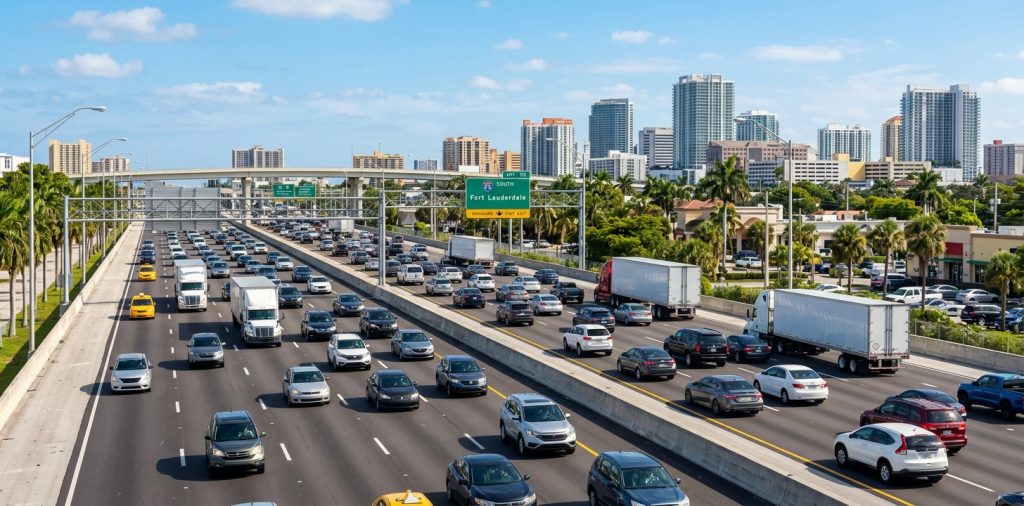
Interstate 95 High speeds, aggressive lane changes, heavy traffic, and distracted drivers make I-95 extremely dangerous for riders. The segment between I-595 and Marina Mile Boulevard — called “America’s Deadliest Mile” — sees frequent motorcycle crashes.
US-1 (Federal Highway) Frequent turning vehicles, commercial driveways, and drivers entering/exiting businesses create constant conflict points for riders traveling through.
A1A Narrow coastal road with heavy tourist traffic, pedestrians, and cyclists. Tourists unfamiliar with local roads often fail to check for motorcycles.
Broward Boulevard Rush-hour congestion and frequent sudden stops put riders at risk of rear-end collisions.
Sunrise Boulevard High speeds, complex intersections, and aggressive driving. Multiple serious motorcycle crashes near the 2400 block and I-95 interchange.
Las Olas Boulevard Heavy pedestrian traffic and distracted drivers in entertainment districts.
| Case Overview | Details |
|---|---|
| The Situation | Our client was riding behind an ambulance on a Broward County road when the ambulance stopped suddenly, causing a collision. Police arrived at the scene and cited our client — the motorcyclist — for following too closely. The insurance company denied the claim entirely, pointing to the citation as proof that the rider was at fault. |
| Insurance Company’s Position | “Your client was cited at the scene. He was following too closely. He caused this accident. Claim denied.” |
| Our Investigation | We did not accept the police report as the final word. We: • Interviewed witnesses who saw the ambulance stop without warning • Obtained the ambulance’s GPS and dispatch records • Consulted accident reconstruction experts • Documented the ambulance driver’s failure to signal or brake appropriately. • Proved the ambulance driver — not our client — was at fault |
| The Result | $2,500,000 — recovered for our client despite being cited at the scene. |
The citation was wrong. The insurance company’s denial was wrong. We proved it.
Past results do not guarantee future outcomes. Every case is evaluated on its individual facts.
Motorcyclists lack the protection of an enclosed vehicle. Even with helmets and protective gear, crashes often result in severe, life-altering injuries:
Even with a helmet, the forces of a motorcycle crash can cause concussions, contusions, and severe traumatic brain injuries. Symptoms may not appear immediately. TBI can result in cognitive impairment, personality changes, and permanent disability.
The impact of a motorcycle crash can damage the spinal cord, resulting in partial or complete paralysis. Spinal injuries often require lifetime medical care, adaptive equipment, and home modifications.
When a rider slides across pavement, the friction strips away skin and tissue. Severe road rash can:
Arms, legs, wrists, ankles, ribs, pelvis, and collarbone fractures are common in motorcycle crashes. Some require surgery with plates, screws, or rods. Some result in permanent limitation of movement.
The blunt force of impact can damage internal organs including the liver, spleen, kidneys, and lungs. Internal bleeding may not be immediately apparent and can be life-threatening.
Crush injuries and severe trauma can result in the loss of limbs — either at the scene or through surgical amputation after the accident.
The most devastating outcome. When a rider is killed, surviving family members face not only grief but also financial hardship from lost income and support.
Insurance adjusters are trained to minimize motorcycle claims. Carlos D. Cabrera knows these tactics because he used to develop them as insurance defense counsel. Here is what to expect:
“Motorcycles are hard to see.”
Adjusters argue that the driver could not have seen the motorcycle — shifting blame away from the driver who failed to look. The law requires drivers to look for all road users, including motorcycles.
“The rider wasn’t wearing a helmet.”
Even when helmet use is not legally required, insurers argue that not wearing a helmet contributed to injuries — and use this to reduce damages. Helmet use does not determine who caused the crash.
“The rider was probably speeding.”
Without evidence, adjusters assume motorcyclists were exceeding the speed limit. Assumptions are not evidence. We demand proof.
“Motorcyclists weave through traffic.”
Adjusters stereotype riders as reckless lane-splitters. Lane splitting is illegal in Florida. Stereotypes are not evidence of what happened in your crash.
“He assumed the risk.”
The argument that choosing to ride a motorcycle means accepting the risk of injury — regardless of who caused the crash. This argument has no legal basis. Negligent drivers are responsible for the harm they cause.
“The rider’s injuries aren’t that bad.”
Adjusters hire “independent” medical examiners who routinely minimize injury severity. We work with your treating physicians to document the true extent of your injuries.
Carlos D. Cabrera knows these arguments because he used to make them. Now he defeats them.
Florida’s PIP (Personal Injury Protection) no-fault insurance does not apply to motorcycles. This is a critical difference from car accidents.
What this means for you:
This makes early evidence preservation and investigation critical in motorcycle cases.
Florida does not require helmets for riders over 21 who carry at least $10,000 in medical insurance coverage.
However, insurance companies use helmet non-use against riders:
Wearing a helmet is the safest choice — and removes this argument from the table.
Florida follows a modified comparative negligence rule:
Insurance companies aggressively argue that motorcyclists share fault — or bear all fault — for crashes. Countering these arguments requires experience and evidence.
You have two years from the date of the accident to file a personal injury lawsuit in Florida.
Missing this deadline eliminates your right to compensation — no matter how serious your injuries.
If you were injured in a motorcycle accident in Fort Lauderdale, you may be entitled to compensation for:
If a loved one was killed in a motorcycle accident:

Most motorcycle accident Lawyers have only ever worked on one side of a claim. Carlos D. Cabrera worked on both sides.
Before law school, Carlos worked as insurance defense counsel. He:
Then he went to work for a personal injury firm — which is where he decided to switch sides and represent injury victims himself.
When Carlos takes your motorcycle case, he already knows what the insurance company will argue. “Hard to see.” “Assumed the risk.” “Wasn’t wearing a helmet.” He has heard them all — because he used to make them.
Now he defeats them. The $2.5 million recovery for a rider who was cited at the scene proves it.
Education
Bar Admissions
Credentials & Recognitions:
Learn more about Carlos D. Cabrera →
We work on a contingency fee basis. That means:
You will never receive a bill from us while your case is active. We only get paid when you do.
If you were injured while riding in Fort Lauderdale, contact Florida Advocates today. Your consultation is free and confidential. You pay nothing unless we recover for you.
Call: 754-290-3803
Email: info@fladvocates.com
Office Location: Florida Advocates 45 E Sheridan Street Dania Beach, FL 33004
Hours: Monday – Friday: 9:00 AM – 5:00 PM
Available by phone 24/7 for emergencies
Call us for a free consultation. You pay nothing unless we recover for you. After all, isn’t that what family would do?
 Free Consultation
 Available 24/7
 No Fees Unless You Win