
Your Story Matters. Your Family Matters. Your Results Matter.


Awards and recognitions listed are not indicative of future results. Selection criteria vary by organization.
Florida Brain Injury Lawyer | Broward County & Fort Lauderdale
Florida Brain Injury Lawyer
Brain Injuries Are Invisible — Until They Take Everything. We Build the Evidence That Insurance Companies Cannot Ignore.
Florida Advocates represents traumatic brain injury and concussion victims throughout Florida. From a “mild” concussion that ended a career to a severe TBI requiring lifetime care, every brain injury case shares one defining challenge: insurance companies will try to make it disappear.
Brain injuries are often invisible. There is no cast, no surgical scar, no obvious disability. But the changes are profound — in cognition, in personality, in memory, in the ability to work, drive, sleep, parent, and live the life the victim had before.
Insurance companies exploit this invisibility relentlessly. They argue:
- “The CT scan was normal.”
- “There was no loss of consciousness.”
- “The symptoms are subjective.”
- “It’s depression, not brain injury.”
- “It’s a pre-existing condition.”
- “It would have happened anyway.”
Carlos D. Cabrera was insurance defense counsel before he became a trial lawyer. He knows exactly how insurers minimize brain injury cases — because he was trained to do it. Now he defeats that playbook.
We win brain injury cases by combining medical evidence, expert testimony, and the lived experience of clients and their families. We document what changed. We prove what was lost. We pursue maximum compensation that reflects the full scope of a life affected by an invisible injury.
Understanding Traumatic Brain Injury (TBI)
A traumatic brain injury is damage to the brain caused by an external force — a blow, bump, jolt, or penetrating injury to the head. TBIs are categorized by severity:
Mild TBI (Including Concussion)
Often called “concussion.” Despite the name, mild TBI is anything but minor:
- Brief or no loss of consciousness
- Confusion, disorientation, memory gaps
- Headache, dizziness, nausea
- Sensitivity to light or sound
- Difficulty concentrating
- Sleep disturbances
- Irritability and mood changes
The myth: Mild TBI is temporary and resolves quickly.
The reality: A significant percentage of mild TBI patients develop post-concussion syndrome with symptoms lasting months, years, or permanently. Mild TBI can permanently affect cognitive function, work performance, and quality of life.
Insurance companies aggressively dismiss mild TBI cases. We refuse to let them.
Moderate TBI
- Loss of consciousness from minutes to hours
- Confusion lasting days to weeks
- Cognitive, physical, or behavioral deficits lasting months or permanently
- Often visible on imaging (CT or MRI showing bleeding, swelling, or structural damage)
Severe TBI
- Extended loss of consciousness (hours to days or longer)
- Coma in many cases
- Significant brain damage visible on imaging
- Lifelong disability common
- Often requires lifetime medical care, rehabilitation, and assistance
Diffuse Axonal Injury (DAI)
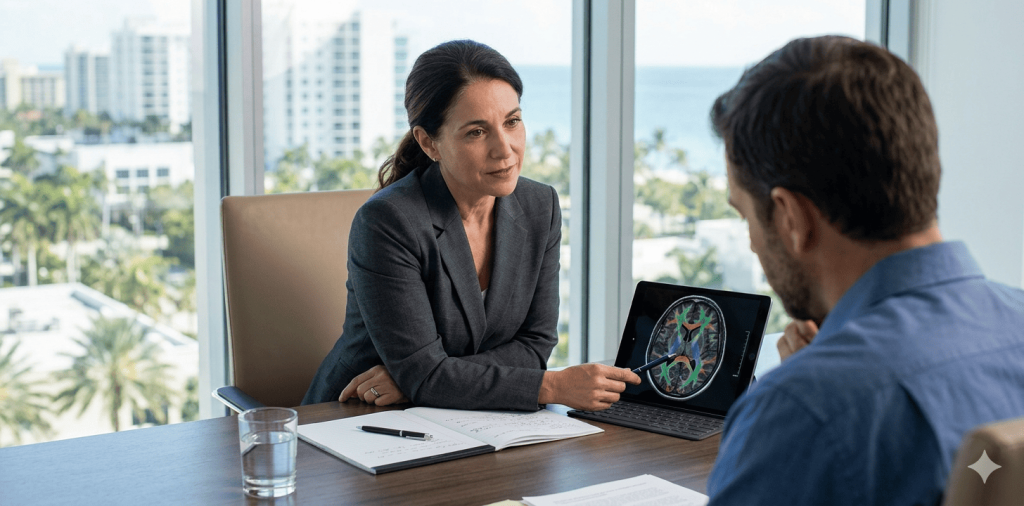
Microscopic damage to the brain’s nerve fibers caused by rapid acceleration-deceleration forces — most common in high-speed motor vehicle crashes. DAI often does not appear on standard imaging but produces severe and permanent cognitive deficits. Advanced imaging like diffusion tensor imaging (DTI) can reveal DAI when standard scans appear normal.
Anoxic and Hypoxic Brain Injury
Brain damage caused by lack of oxygen — from drowning, choking, cardiac arrest, anesthesia errors, or severe blood loss. Even brief oxygen deprivation can cause permanent brain damage. These cases often involve medical malpractice, premises liability (pool drownings), or vehicular trauma.
Penetrating Brain Injury
When an object pierces the skull and enters brain tissue — from violent crime, accidents, or workplace incidents. These injuries are immediately catastrophic and often fatal.
The Invisible Injury Problem — Why TBI Cases Need a Specialist
The fundamental challenge in brain injury litigation is that brain injuries often produce no visible evidence:
CT Scans Often Appear Normal
Standard CT scans look for bleeding, swelling, and gross structural damage. Most mild and many moderate TBIs do not produce findings visible on CT. An insurance company’s first move is almost always to point to the “normal” CT scan as proof that no real injury occurred.
We counter this with:
- Detailed emergency room records
- Glasgow Coma Scale documentation
- Neurological examination findings
- Symptom documentation from the first hours after injury
MRI Scans Can Also Appear Normal
Standard MRI is more sensitive than CT but still misses many brain injuries — particularly diffuse axonal injuries, microbleeds, and subtle structural changes. Advanced imaging like DTI (diffusion tensor imaging) can reveal damage standard MRI misses.
Neuropsychological Testing Reveals What Imaging Cannot
Comprehensive neuropsychological testing measures cognitive function across multiple domains — memory, attention, processing speed, executive function, language, and emotional regulation. This testing provides objective evidence of cognitive deficits that imaging may not capture.
We coordinate with established neuropsychologists to obtain comprehensive testing in every appropriate brain injury case.
Before-and-After Evidence
Brain injury cases are won as much in the lived experience of clients and their families as in the medical records. We document:
- Pre-injury work performance, relationships, and capabilities
- Specific changes family members have observed
- Coworker testimony about workplace function
- Friends’ observations about social and behavioral changes
- Detailed daily symptom journals
- Video documentation of functional changes when appropriate
This evidence carries enormous weight with juries. They understand that the people closest to a brain injury victim know what changed.
Common Symptoms of Brain Injury
Brain injury symptoms fall into four broad categories. Many TBI victims experience symptoms across all four:
Physical Symptoms
- Persistent headaches
- Dizziness and balance problems
- Nausea and vomiting
- Fatigue
- Sleep disturbances (insomnia or excessive sleep)
- Sensitivity to light and sound
- Vision problems
- Seizures (in some cases)
Cognitive Symptoms
- Memory problems, particularly short-term memory
- Difficulty concentrating
- Slow processing speed
- Difficulty following conversations
- Difficulty with multitasking
- Word-finding problems
- Difficulty making decisions
- Disorientation
Emotional Symptoms
- Depression
- Anxiety
- Mood swings
- Irritability and anger
- Emotional flatness
- Loss of motivation
Behavioral Symptoms
- Impulsivity
- Personality changes
- Social withdrawal
- Difficulty controlling impulses
- Disinhibition
These symptoms are real, measurable, and compensable. Insurance companies who dismiss them are wrong — and we use medical evidence to prove it.
Common Causes of Florida Brain Injuries
Brain injuries can result from many types of incidents. We represent victims of brain injuries caused by:
Motor Vehicle Crashes
- Car accidents — particularly high-speed, T-bone, and head-on crashes
- Motorcycle accidents — no head protection beyond a helmet
- Truck and commercial vehicle crashes
- Bicycle and pedestrian crashes
- Rideshare accidents
Falls
- Falls from height (construction, balconies, ladders)
- Slip and fall on hazardous property
- Falls in apartment buildings (negligent stair maintenance)
- Senior falls in nursing homes or assisted living
Sports and Recreational Injuries
- Recreational vehicle accidents (boating, jet ski, ATV)
- Pool injuries and drownings (anoxic brain injury)
- Sports-related impacts when negligence is involved
Assault and Violence
- Negligent security cases where assault occurred on inadequately secured property
- Bar and entertainment venue assaults
Workplace Incidents
- Construction accidents
- Industrial machinery accidents
- Workplace falls
- (Beyond workers’ compensation, when third-party liability exists)
Medical Malpractice
- Anesthesia errors
- Surgical errors
- Failure to monitor oxygen levels
- Failure to diagnose conditions that affect the brain
Premises Liability
- Drownings due to inadequate pool security
- Falls due to negligent property maintenance
- Carbon monoxide poisoning
Florida Brain Injury Law — Key Considerations
Statute of Limitations — Two Years
Two years from the date of the injury to file a personal injury lawsuit. Two years from the date of death to file a wrongful death claim. Missing these deadlines permanently eliminates your right to compensation.
Brain injury cases require early evidence preservation. Imaging records, emergency room documentation, witness statements, and surveillance footage from the incident must be secured early. Contact us as early as possible.
Modified Comparative Negligence
Under Florida Statute § 768.81, revised in March 2023:
- Recovery is reduced by your percentage of fault
- If you are more than 50% at fault, you cannot recover any damages
Insurance companies push fault aggressively in brain injury cases. We build the evidence that defeats their fault-shifting arguments.
PIP Coverage Applies — But Is Capped
Florida PIP under Florida Statute § 627.736 covers brain injuries from motor vehicle crashes — but is capped at $10,000 (or $2,500 if not classified as an emergency medical condition). The 14-day rule still applies.
PIP is a starting point only. Brain injury damages routinely exceed PIP coverage many times over. We pursue every additional source of recovery.
Insurance Bad Faith — The TBI Multiplier
When brain injury damages clearly exceed policy limits, Florida Statute § 624.155 bad faith law becomes critical. An insurer that refuses to settle a clear-liability brain injury case within policy limits can be held liable for the entire jury verdict — including amounts that exceed the original policy limits.
Bad faith can transform a $100,000 policy into a multi-million dollar recovery in a severe TBI case. We document the bad faith predicate from the first day of every brain injury case.
Learn more about insurance bad faith →
Wrongful Death from Brain Injury
When a brain injury results in death, surviving family members can pursue wrongful death claims under Florida Statute § 768.16.
Learn more about wrongful death claims →
What Insurance Companies Do in Brain Injury Cases
Carlos D. Cabrera spent years inside the insurance industry. Here is the brain injury insurance playbook:
The “Normal Scan” Defense
The first move in nearly every TBI case. “The CT scan was normal. The MRI was normal. Therefore, there is no real injury.” This argument is medically outdated and ignores everything modern neuroscience knows about brain injury. We defeat it with neuropsychological testing, advanced imaging, and expert testimony.
The “No Loss of Consciousness” Defense
“The patient never lost consciousness, so there was no real impact.” Wrong. Mild and moderate TBIs frequently involve no loss of consciousness but still produce significant cognitive and behavioral changes. The medical community has moved away from loss of consciousness as the defining factor in brain injury diagnosis.
The “Subjective Symptoms” Defense
“The symptoms are entirely subjective — there is no objective evidence.” Wrong. Neuropsychological testing provides objective, measurable evidence of cognitive deficits. Advanced imaging can reveal structural damage. Coworkers and family can document objective behavioral changes.
The “Pre-Existing Condition” Defense
“The patient had headaches/depression/sleep issues before the crash.” Even when partially true, this doesn’t eliminate liability. Florida law recognizes the “eggshell plaintiff” rule — the at-fault party takes the victim as they find them. Aggravation of a pre-existing condition is fully compensable.
The “Independent Medical Examination” Tactic
The insurer hires a doctor — paid by them, working for them — to conclude the injuries are minor or unrelated. We anticipate this and prepare to challenge IME doctors’ credibility, methodology, and bias.
The Quick Settlement Push
Brain injury symptoms often worsen over time. Insurers know this and push quick settlements before the full extent of injury is documented. Accepting a settlement before reaching maximum medical improvement in a brain injury case routinely costs victims 50-80% of the case value.
The “Just Depression” Argument
When mood and cognitive changes are documented, insurers argue these are psychological, not neurological. Both can be true — and brain injury can cause depression. We document the neurological underpinnings of mood changes.
The moment you retain Florida Advocates, all communication with the insurance company goes through us. You will not be recorded, pressured, or misled. We handle the insurance company while you focus on recovery.
Damages We Pursue in Florida Brain Injury Cases
Economic Damages — Past and Future
- All medical expenses (emergency care, surgery, hospitalization, rehabilitation, future treatment)
- Future medical expenses (often substantial — TBI requires long-term care)
- Lost wages (past and future)
- Reduced earning capacity from cognitive deficits
- Vocational rehabilitation costs
- Home modifications for severe TBI
- Adaptive equipment
- Lifetime caregivers and personal assistance for severe TBI
- Cognitive therapy and rehabilitation
Non-Economic Damages
- Pain and suffering (past and future)
- Emotional distress (PTSD, anxiety, depression caused or worsened by TBI)
- Permanent cognitive disability
- Loss of enjoyment of life
- Loss of consortium (impact on relationship with spouse)
- Loss of capacity to parent or work
Wrongful Death Damages
When a brain injury results in death:
- Funeral and burial expenses
- Lost financial support
- Loss of companionship, guidance, and protection
- Mental pain and suffering of survivors
Punitive Damages
Available when the conduct causing the brain injury was egregious — drunk driving, hit-and-run, reckless driving — under Florida Statute § 768.72.
Bad Faith Damages
When an insurer refuses to settle a clear brain injury case within policy limits, recovery can exceed those limits.
What to Do After a Suspected Brain Injury
At the Scene or Immediately After
- Accept emergency medical evaluation — even if you feel fine, brain injury symptoms can emerge later
- Tell the paramedics or ER doctors about any head impact — even minor impacts
- Mention symptoms even if mild — headache, confusion, nausea, light sensitivity
- Photograph any visible head injury if it can be done safely
Within 14 Days
SEE A DOCTOR WITHIN 14 DAYS to preserve PIP benefits — even if your motor vehicle crash brain injury seems mild. Miss the 14-day window and you forfeit PIP coverage permanently.
- See a doctor within 14 days for any motor vehicle crash
- Document all symptoms — keep a daily journal of headaches, memory issues, mood changes, sleep changes, light sensitivity, and any cognitive struggles
- Note any specific incidents — forgetting names, getting lost, missing appointments
Critical Symptom Documentation
Brain injury symptoms can be the difference between a winning case and a lost one. Document everything: every headache, every memory lapse, every emotional reaction, every cognitive difficulty. Have family members document what they see, too.
- Keep a daily symptom journal — date, time, symptom, severity, impact
- Have family members and coworkers document changes they observe
- Save communications with employers about reduced work capacity
- Document any changes to daily routine necessitated by symptoms
Specialist Care
- Request referral to a neurologist for evaluation
- Request referral for neuropsychological testing if symptoms persist beyond a few weeks
- Follow all treatment recommendations
Protect Your Claim
- Do NOT give recorded statements to any insurance company
- Do NOT sign anything from an insurance adjuster
- Do NOT accept a quick settlement offer
- Do NOT post on social media about the injury
- Contact Florida Advocates for a free consultation
The Experts We Build Brain Injury Cases With
Brain injury cases are won with expert testimony. Our network includes:
- Neurologists — Document brain injury severity and neurological findings
- Neuropsychologists — Conduct comprehensive cognitive testing
- Neuroradiologists — Interpret advanced imaging including DTI when appropriate
- Life Care Planners — Project lifetime cost of care for severe TBI cases
- Vocational Rehabilitation Experts — Establish lost earning capacity from cognitive deficits
- Economists — Calculate present value of future losses
- Cognitive Therapists — Document rehabilitation needs and progress
- Treating Physicians — Provide credibility-anchored medical testimony
We advance the costs of all experts. You pay nothing while the case is active.
Frequently Asked Questions — Florida Brain Injury Cases
What is a traumatic brain injury (TBI)?
A traumatic brain injury is damage to the brain caused by an external force — most commonly a sudden impact, blow, or jolt to the head. TBIs range from mild to moderate to severe. Even mild TBIs can produce long-term cognitive, emotional, and behavioral changes that affect a person’s ability to work, sleep, drive, and maintain relationships. Severe TBIs frequently cause permanent disability and require lifetime medical care.
Can I have a brain injury even if I never lost consciousness?
Yes. The medical community has moved away from loss of consciousness as the defining symptom of brain injury. Many people sustain serious TBIs without ever losing consciousness — they may experience confusion, disorientation, headache, dizziness, nausea, or memory problems instead. Insurance companies aggressively use the lack of loss of consciousness to deny TBI cases. We defeat this argument with neurological evidence, neuropsychological testing, and expert testimony.
Why are brain injury cases so hard to win?
Brain injuries are often invisible. There is no broken bone, no surgical scar, no visible disability — but the cognitive, emotional, and behavioral changes are profound. Insurance companies exploit this by arguing the injury is exaggerated or pre-existing. We win brain injury cases by combining neuropsychological testing, advanced imaging like DTI, expert testimony, before-and-after evidence from family and coworkers, and detailed documentation of how the injury changed the client’s life.
How much is a Florida brain injury case worth?
Brain injury cases vary widely. A mild TBI with complete recovery might settle in the mid-five figures. A moderate TBI with lasting cognitive deficits typically settles in the six to low-seven figures. A severe TBI requiring lifetime care can reach eight figures or more. Value depends on the injury’s severity, the victim’s age and earning capacity, the available insurance coverage, and the strength of the liability evidence.
What evidence is most important in a Florida brain injury case?
Brain injury cases turn on a combination of medical evidence and lived-experience evidence: emergency room records and Glasgow Coma Scale scores, CT and MRI imaging (and advanced imaging like DTI when appropriate), neuropsychological testing, treating neurologist documentation, before-and-after testimony from family, friends, and coworkers, detailed symptom journals, employment records showing performance changes, expert testimony, and life care planning for severe cases.
What is post-concussion syndrome and is it compensable?
Post-concussion syndrome (PCS) is a condition where symptoms of concussion persist for weeks, months, or years after the initial injury. Symptoms include headaches, dizziness, fatigue, memory problems, difficulty concentrating, irritability, sleep disturbances, and depression. PCS is fully compensable under Florida personal injury law.
How long do I have to file a Florida brain injury claim?
Two years from the date of the injury under Florida’s modified statute of limitations for personal injury. Wrongful death claims must be filed within two years of the date of death. Government entity defendants have additional pre-suit notice requirements. Brain injury cases require early evidence preservation.
What if my brain injury was caused by a car accident with low policy limits?
Brain injury damages frequently exceed standard policy limits. We pursue every available source of recovery: the at-fault party’s primary policy, your own UM/UIM coverage, umbrella policies, employer liability, vehicle owner liability under Florida’s dangerous instrumentality doctrine, third-party liability for additional negligent parties, and bad faith claims when insurers refuse to settle within limits.
Why Carlos D. Cabrera for Your Florida Brain Injury Case

IInsurance Insider Experience
Brain injury cases are where insurance insider experience matters most. Before law school, Carlos D. Cabrera worked as insurance defense counsel. He:
- Evaluated brain injury claims for an insurance carrier
- Set reserves on TBI cases
- Reviewed medical records and imaging to identify factors that supported denial or low offers
- Developed valuation arguments insurers use against TBI victims
- Was selected to handle his firm’s largest and most complex insurance defense matters, managing high-exposure claims under specialized protocols
When Carlos takes a brain injury case, he already knows what arguments the insurance company will make, what reserves they’ve set, and what tactics they will deploy. He uses that knowledge to defeat the playbook.
Bad Faith Litigation Experience
Carlos has handled bad faith claims throughout his 24+ years of insurance litigation. Brain injury cases are textbook bad faith setups — and Carlos knows how to build the predicate from day one.
Federal Court Experience
Brain injury cases often involve out-of-state defendants, federal questions, or damages that allow for federal diversity jurisdiction. Carlos is admitted to all three U.S. District Courts in Florida — Southern, Middle, and Northern.
Education
- J.D. — St. Thomas University College of Law (2000)
- Managing Editor, St. Thomas Law Review
- B.A. English — Florida International University (1994)
Bar Admissions
- The Florida Bar
- U.S. District Court, Southern District of Florida
- U.S. District Court, Middle District of Florida
- U.S. District Court, Northern District of Florida
Credentials & Recognitions
- Million Dollar Advocates Forum Member
- Multi-Million Dollar Advocates Forum Member
- Florida Legal Elite Recognition
- Lead Counsel Verified (Appellate, since 2015)
- Former Insurance Defense Counsel
Learn more about Carlos D. Cabrera →
No Fee Unless We Win
We work on a contingency fee basis:
- Free consultation — no cost to speak with us
- No upfront fees — we advance all case costs (filing fees, neuropsychological testing, advanced imaging, expert witnesses, life care planners, economists, medical records)
- No fees unless we recover for you
Brain injury cases involve substantial expert costs — neuropsychologists, neurologists, neuroradiologists, life care planners. We advance all of these costs. You pay nothing while the case is active.
About Florida Advocates
Florida Advocates is a statewide personal injury law firm headquartered in Dania Beach, Florida, with additional offices in North Miami, Tampa, Miami, Orlando, and Tallahassee. We represent injured clients and families throughout Florida.
Office Locations:
Dania Beach (Broward County) — Headquarters
45 E Sheridan Street Dania Beach, FL 33004
North Miami (Miami-Dade County)
13499 Biscayne Blvd #107 North Miami, FL 33181
Tampa (Hillsborough County)
238 E Davis Blvd #210 Tampa, FL 33606
Phone: 754-290-3803
Email: info@fladvocates.com
Hours: Monday – Friday: 9:00 AM – 5:00 PM
Available by phone 24/7 for emergencies
Contact a Florida Brain Injury Lawyer
If you or a loved one has suffered a brain injury — whether mild, moderate, or severe — contact Florida Advocates today. Time matters. Imaging records, witness statements, and accident scene evidence all deteriorate quickly. The sooner we begin documenting your injury, the more we can recover for you.
Phone: 754-263-4252
Email: info@fladvocates.com
Call us for a free consultation. You pay nothing unless we recover for you. After all, isn’t that what family would do?
Communities We Serve Throughout Florida
- Fort Lauderdale and Broward County
- Fort Myers and Lee County
- Miami and Miami-Dade County
- Tampa and Hillsborough County
- Orlando and Orange County
- Hollywood, Pompano Beach, Coral Springs, Plantation
- Cape Coral, Bonita Springs, Estero, Sanibel
- Statewide representation available
Related Pages
Contact Us
Fill out the contact form or call us at 754-290-3803 to schedule your free consultation. Free Consultation
  Available 24/7
  No Fees Unless You Win