
Your Story Matters. Your Family Matters. Your Results Matter.


Awards and recognitions listed are not indicative of future results. Selection criteria vary by organization.
Fort Lauderdale Bicycle Accident Lawyer
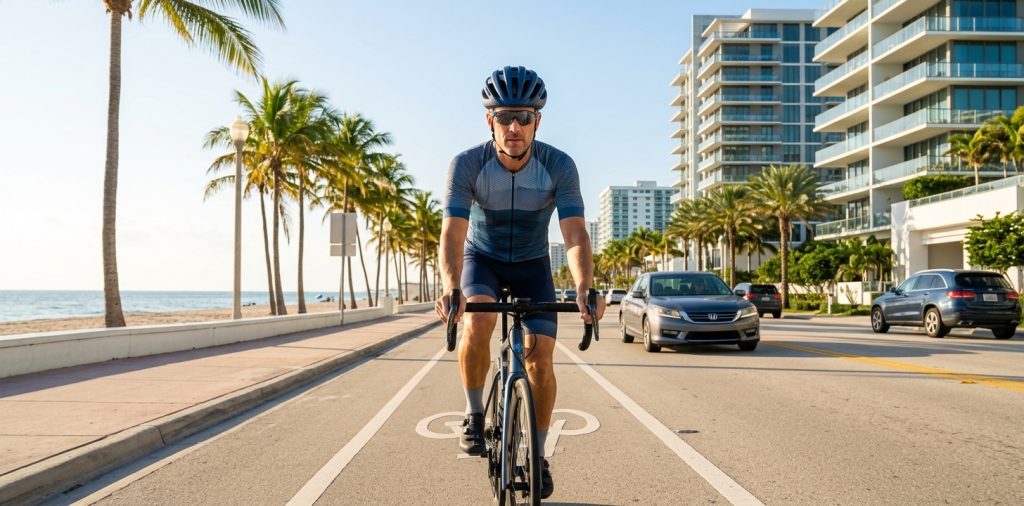
Florida Is One of the Deadliest States in the Nation for Cyclists. When Drivers Blame Riders for Crashes That Weren’t Their Fault, We Prove What Really Happened.
Florida Advocates represents bicycle accident victims throughout Fort Lauderdale, Hollywood, Pompano Beach, and Broward County. When a driver hits you on A1A, US-1, Las Olas Boulevard, Sunrise Boulevard, or any road in Broward County, the bias starts immediately — at the scene, in the police report, and especially with the insurance adjuster reviewing your claim.
Cyclists get blamed for crashes that weren’t their fault. “They came out of nowhere.” “They weren’t wearing a helmet.” “They didn’t have lights.” “They were in the road.”
We know better. Carlos D. Cabrera was insurance defense counsel before he became a trial lawyer. He knows exactly how insurers defend against cyclist claims — because he helped write the playbook. Now he defeats it.
Florida Cyclist Statistics — A Public Safety Crisis
According to the Florida Department of Highway Safety and Motor Vehicles and federal data:
| Statistic | Approximate Annual Figure |
|---|---|
| Florida bicycle crashes (2023) | 6,400+ |
| Florida cyclist injuries (2023) | 5,800+ |
| Florida cyclist fatalities (2023) | 200+ |
| Florida’s national rank for cyclist fatality rate | Consistently top 3 |
Broward County is one of the deadliest counties in the nation for cyclists. In 2023, Broward County recorded approximately:
- 888 bicycle crashes
- 9 cyclist fatalities
- High concentrations of crashes on A1A, US-1, and downtown Fort Lauderdale corridors
Broward County’s risk factors for cyclists include:
- Year-round riding season — no winter slowdown means crash exposure stays high
- Tourist-heavy traffic — visitors unfamiliar with Florida roads, often distracted by GPS or scenery
- Dense urban riding — Fort Lauderdale’s downtown and beach area mix cars, cyclists, scooters, and pedestrians
- A1A coastal corridor — heavy traffic on a road with limited bike infrastructure in many sections
- Senior demographic — both senior drivers (slower reactions) and senior cyclists (higher injury severity)
- Rideshare and delivery vehicles — drivers focused on phones and apps rather than the road
The reality is harsh: a cyclist hit by a car is far more likely to suffer catastrophic injuries than the driver of any vehicle. No frame, no airbags, no crumple zones. When a driver fails to see you, cuts you off, or violates the 3-foot passing rule, the injuries that follow are often life-changing.
Florida Bicycle Law — What Drivers and Insurers Don’t Want You to Know
Bicycles Are Vehicles Under Florida Law
Under Florida Statute § 316.2065, bicycles are vehicles. Cyclists have the same rights and duties as motor vehicle operators in most situations.
This is critical because insurance adjusters often treat cyclists as second-class road users — as if cyclists need to justify their presence on the road. They don’t. Cyclists have full rights to use the road.
The 3-Foot Passing Rule
Under Florida Statute § 316.083, drivers must give cyclists at least 3 feet of clearance when passing. This is one of the most important safety laws in Florida — and one of the most violated.
When a driver passes too closely and clips a cyclist, sideswipes them, or causes them to swerve and crash, the 3-foot violation is strong evidence of negligence. We obtain:
- Dashcam footage from the driver’s vehicle, nearby vehicles, and rideshare cars
- Surveillance footage from businesses along the road
- Witness statements from other drivers and pedestrians
- Cyclist GPS and helmet camera data when available
- Roadway measurements showing the available passing distance
Helmet Law — Adults Are Not Required
Under Florida Statute § 316.2065(3)(d), bicycle helmets are required only for riders under 16 years old. Adult cyclists are not legally required to wear helmets.
But insurance companies use helmet non-use against adult cyclists anyway. They argue:
- Lack of helmet contributed to head injuries
- Comparative fault based on helmet choice
- “Failure to mitigate” reducing damage awards
We anticipate this argument in every case involving an unhelmeted cyclist with head injuries. We counter with medical evidence showing the actual cause of injuries and expert testimony where necessary.
Wearing a helmet is the safest choice — and removes this argument entirely from the table.
Cyclist Lane Position Rights
Florida law allows cyclists to:
- Take the full lane when the lane is too narrow to share safely with a passing vehicle (with 3 feet of clearance)
- Ride two abreast when not impeding traffic
- Use sidewalks in some jurisdictions (Fort Lauderdale generally permits sidewalk cycling outside the central business district)
- Use bicycle lanes but is not required to use them in every situation
Insurance adjusters often argue cyclists were “in the wrong place” when they were actually exercising their legal rights.
Modified Comparative Negligence — Effective March 2023
Florida’s modified comparative negligence rule under Florida Statute § 768.81, revised in March 2023:
- If you are partially at fault below 50%, your recovery is reduced by your percentage of fault
- If you are more than 50% at fault, you cannot recover any damages
Insurers aggressively push fault onto cyclists for:
- Lighting (or lack of it) at dawn, dusk, or night
- Clothing color and visibility
- Lane position
- Helmet use
- Whether you “should have seen” the driver
Building the evidence that defeats these arguments is core to how we handle bicycle accident cases.
Statute of Limitations — Two Years
Two years from the date of the accident to file a personal injury lawsuit. Missing this deadline permanently eliminates your right to compensation.
Surveillance footage from intersections, businesses, and traffic cameras may be deleted within days. Witness recollections fade. Physical evidence is repaired or discarded. Contact us as early as possible.
The Most Common Bicycle Accident Patterns
Right-Hook Crashes
A driver passes a cyclist, then immediately turns right across the cyclist’s path — striking the cyclist or forcing them to crash. This is one of the most common driver-fault crash patterns and often involves clear traffic law violations.
Left-Cross Crashes
A driver turning left across oncoming traffic fails to see (or misjudges the speed of) an oncoming cyclist and strikes them in the intersection. The driver almost always claims “they came out of nowhere.” We use accident reconstruction and sight-line analysis to prove what the driver should have seen.
Dooring Incidents
A driver or passenger opens a vehicle door into a cyclist’s path. Florida law requires drivers to ensure their door movements do not interfere with traffic. Dooring is a particular hazard in Fort Lauderdale’s downtown core, the Las Olas area, and any area with parallel parking adjacent to bike lanes or shoulders.
Rear-End Crashes
Distracted drivers strike cyclists from behind — often at night or during low-light conditions. The 3-foot passing rule and basic vigilance duties mean these crashes are almost always the driver’s fault, regardless of cyclist lighting.
Hit-and-Run Crashes
When a driver flees the scene, your own uninsured motorist (UM) coverage typically applies. We work with law enforcement and surveillance footage to identify the driver when possible — and pursue UM coverage when the driver cannot be identified.
3-Foot Violations
Drivers passing too closely cause “swipe” injuries even without direct contact. The wind from a too-close pass at highway speed can cause cyclists to crash. These cases often require detailed roadway measurements and witness testimony.
Drinking and Driving Crashes
DUI crashes against cyclists are particularly devastating. When alcohol or drugs are involved, additional claims may apply, including:
- Punitive damages under Florida Statute § 768.72
- Dram shop claims under Florida Statute § 768.125 against bars or restaurants that overserved the driver
Construction Zone Crashes
Inadequate cyclist accommodations in construction zones — narrow lanes, dropped pavement, debris, missing signs — can support claims against the construction company, the contractor, or the government entity responsible for the work zone.
PIP Coverage for Cyclists — A Benefit Most Don’t Know About
Here is something most cyclists do not realize: if you own a car with PIP coverage, your auto PIP applies when you are hit by a motor vehicle while riding your bicycle.
This is a significant benefit that many injured cyclists fail to claim:
- 80% of reasonable medical expenses — up to $10,000 (or $2,500 if not classified as an emergency medical condition)
- 60% of lost wages
- $5,000 death benefits
If you do not own a car but a household relative does, that relative’s PIP policy may apply.
The 14-day rule still applies: You must seek medical treatment within 14 days of the accident to qualify for PIP benefits — even if your injuries seemed minor at the time.
The 14-Day Rule applies to bicycle crashes. See a doctor within 14 days of being hit — even if you feel fine — or you forfeit your PIP benefits.
Learn more about PIP coverage →
What If the Driver Was Uninsured? UM/UIM for Cyclists
If the driver who hit you had no insurance or insufficient insurance, your own auto UM/UIM coverage may apply — even though you were on a bicycle when the crash happened.
UM/UIM coverage protects cyclists when:
- The at-fault driver had no liability insurance (uninsured)
- The at-fault driver’s policy limits were too low to cover your damages (underinsured)
- The driver fled the scene and was never identified (hit-and-run)
This is one of the most overlooked sources of cyclist recovery. Many people assume UM/UIM only applies when they are driving a car. It does not. Your auto UM/UIM coverage protects you on a bicycle, on foot as a pedestrian, and in many other circumstances.
Learn more about UM/UIM and denied insurance claims →
Common Cyclist Injuries
Bicycle crashes produce some of the most severe injuries we see. Without the protection of a vehicle frame, cyclists absorb the full force of impact and the secondary impact with pavement.
Traumatic Brain Injury (TBI)
Even with a helmet, the forces of a bicycle crash can cause concussions, contusions, and severe traumatic brain injuries. Without a helmet, the risk is dramatically higher.
Spinal Cord Injuries
Herniated discs, nerve damage, and in severe cases partial or complete paralysis. Spinal injuries often require lifetime medical care.
Road Rash
When a cyclist slides across pavement, the friction strips away skin and tissue. Severe road rash can:
- Penetrate through skin to muscle and bone
- Require skin grafts and multiple surgeries
- Cause permanent scarring and disfigurement
- Lead to serious infection
Fractures
- Fractured collarbone — extremely common in bicycle crashes
- Broken wrists, arms, and shoulders (from bracing during impact)
- Fractured pelvis, hip, and femur
- Facial fractures and dental injuries
Internal Injuries
The blunt force of impact can damage internal organs. Internal bleeding may not be immediately apparent and can be life-threatening.
Crush Injuries and Amputation
When a cyclist is struck by a heavy vehicle, crush injuries can be severe — sometimes requiring surgical amputation.
Psychological Injuries
- Post-traumatic stress disorder (PTSD)
- Anxiety and fear of riding
- Depression
- Sleep disturbances
Wrongful Death
When a cyclist is killed, surviving family members can pursue wrongful death damages. Learn more about wrongful death claims →
Dangerous Roads for Cyclists in Fort Lauderdale
We see cyclist crashes from these corridors regularly:
- A1A (Atlantic Boulevard / Ocean Drive) — high-speed coastal road with heavy tourist traffic and limited bike infrastructure in many sections
- US-1 (Federal Highway) — major north-south arterial with frequent driveway and intersection conflicts
- Las Olas Boulevard — downtown Fort Lauderdale’s main artery, with heavy parallel parking creating dooring risks
- Sunrise Boulevard — multi-lane east-west corridor with high speeds
- 17th Street Causeway — connects Fort Lauderdale to Port Everglades, heavy commercial traffic
- Hollywood Boulevard — popular cyclist route with frequent intersection conflicts
- Andrews Avenue — north-south downtown corridor
- A1A in Hollywood and Hallandale Beach — coastal stretches with heavy seasonal traffic
- Pine Island Road — east-west corridor through Plantation
- University Drive — north-south corridor through Davie
If you were injured on any of these roads or anywhere else in Broward County, contact us for a free consultation.
What Insurance Companies Do When a Cyclist Files a Claim
Carlos D. Cabrera spent years inside the insurance industry as defense counsel. Here is what to expect when you file a cyclist injury claim:
Common Insurance Tactics Against Cyclists
Shifting blame onto the cyclist before investigating the facts Adjusters assume the cyclist was somehow at fault — riding too fast, in the wrong place, without proper visibility — regardless of what the evidence shows.
Using helmet non-use against you Even when helmet use is not legally required, insurers argue lack of helmet contributed to head injuries.
Claiming the cyclist “came out of nowhere” This is the standard driver excuse and standard adjuster talking point. We use sight-line analysis, speed calculations, and witness testimony to show what the driver should have seen.
Disputing visibility based on lighting and clothing At dawn, dusk, or night, adjusters argue the cyclist was not visible enough — even when the cyclist had legally required lighting.
Requesting a recorded statement before you understand your injuries Adjusters call you while you’re still in the hospital or on heavy medications, asking questions designed to get you to minimize symptoms or admit fault.
Making a fast lowball offer Insurers offer quick settlements before you finish medical treatment — before you know how serious your injuries are.
Arguing prior injuries caused current symptoms Any prior medical history becomes the explanation for current symptoms — the crash supposedly didn’t cause anything new.
Hiring “independent” medical examiners Insurance companies pay doctors who consistently conclude that injuries are less serious than treating physicians believe.
The moment you retain Florida Advocates, all communication with the insurance company goes through us. You will not be recorded, pressured, or misled. We handle the insurance company while you focus on your recovery.
What to Do After a Fort Lauderdale Bicycle Accident
At the Scene
- Do not move if you cannot do so safely — let paramedics assess you
- Call 911 — even if injuries seem minor, get an official accident report
- Accept emergency medical treatment — adrenaline masks injury, and cyclist injuries are often more serious than they first appear
- Photograph everything:
- Your bicycle and any visible damage
- The vehicle that hit you
- The driver’s license and insurance card
- The scene from multiple angles
- Your injuries (visible)
- Your helmet (if worn) and clothing
- Skid marks, debris, and road conditions
- Traffic signals and signs
- Get witness contact information — names and phone numbers
- Do NOT discuss fault at the scene — and do not apologize
Within 14 Days
SEE A DOCTOR WITHIN 14 DAYS to preserve PIP benefits. The 14-day rule is strict — even if you feel fine, miss it and you forfeit your PIP coverage permanently.
- See a doctor within 14 days — even if injuries seem minor
- Document all symptoms — keep a daily journal of pain, limitations, and how injuries affect your daily life
- Keep all medical records, bills, and receipts
Preserve Critical Evidence
Preserve your bicycle, helmet, lights, and gear. Do not authorize repairs, do not clean or discard the helmet, do not throw away your gear. Damage patterns on your bicycle and gear are critical evidence — accident reconstruction experts use them to prove what really happened.
- Preserve your bicycle — Do NOT authorize repairs until it has been documented
- Preserve your helmet — Damage patterns show impact direction and force
- Preserve your gear and clothing — Tears, scuffs, and damage corroborate your version of events
- Preserve any lights or reflectors — These defeat “no lights” defenses
Protect Your Claim
- Do NOT give recorded statements to any insurance company
- Do NOT sign anything from an insurance adjuster
- Do NOT accept a quick settlement offer
- Do NOT post on social media about the accident
- Contact Florida Advocates for a free consultation
Damages You Can Pursue
Economic Damages
- Medical expenses — emergency care, surgery, hospitalization, rehabilitation, future treatment, skin grafts for road rash
- Lost wages — past and future
- Reduced earning capacity from permanent disability
- Property damage — bicycle replacement, helmet, gear, electronics damaged in the crash
- Home modifications — for catastrophic injuries
- Adaptive equipment — prosthetics, mobility devices
Non-Economic Damages
- Pain and suffering
- Emotional distress — anxiety, depression, PTSD, fear of riding
- Permanent disability or disfigurement — including road rash scars and amputation
- Loss of enjoyment of life — inability to ride, participate in activities
- Loss of consortium — impact on your relationship with your spouse
Wrongful Death Damages
If a loved one was killed in a Fort Lauderdale bicycle accident:
- Funeral and burial expenses
- Lost financial support
- Loss of companionship, guidance, and protection
- Mental pain and suffering of survivors
Punitive Damages
Available in cases involving egregious conduct — particularly DUI crashes, hit-and-runs, and reckless driving — under Florida Statute § 768.72.
Why Carlos D. Cabrera for Your Fort Lauderdale Bicycle Accident Case

Insurance Insider Experience
Most personal injury lawyers have only ever worked one side of a claim. Carlos D. Cabrera worked on both sides.
Before law school, Carlos worked as insurance defense counsel. He:
- Evaluated injury claims — including pedestrian and cyclist crashes
- Reviewed medical records to identify pre-existing conditions
- Developed the valuation arguments insurers use to justify low offers
- Was selected to handle his firm’s largest and most complex insurance defense matters, managing cases under specialized handling procedures
When Carlos takes a cyclist case, he already knows what the insurance company will argue. “They came out of nowhere.” “No helmet.” “No lights.” “Wrong lane position.” He has heard them all — because he used to make them.
Now he defeats them.
Education
- J.D. — St. Thomas University College of Law (2000)
- Managing Editor, St. Thomas Law Review
- B.A. English — Florida International University (1994)
Bar Admissions
- The Florida Bar
- U.S. District Court, Southern District of Florida
- U.S. District Court, Middle District of Florida
- U.S. District Court, Northern District of Florida
Credentials & Recognitions
- Million Dollar Advocates Forum Member
- Multi-Million Dollar Advocates Forum Member
- Florida Legal Elite Recognition
- Lead Counsel Verified (Appellate, since 2015)
- Former Insurance Defense Counsel
Learn more about Carlos D. Cabrera →
Frequently Asked Questions — Fort Lauderdale Bicycle Accidents
Do I get PIP benefits if I was hit by a car while riding a bicycle in Fort Lauderdale?
Yes, in many cases. If you own a vehicle with PIP coverage, your own auto PIP policy applies when you are injured as a cyclist hit by a motor vehicle. If you do not own a vehicle but a household relative does, that relative’s PIP policy may apply. PIP covers 80% of reasonable medical expenses up to $10,000 and 60% of lost wages — regardless of who caused the crash. The 14-day rule still applies: you must seek medical treatment within 14 days of the accident to qualify for PIP.
What is Florida’s 3-foot passing rule for cyclists?
Florida Statute § 316.083 requires drivers to give cyclists at least three feet of clearance when passing. Violations are strong evidence of driver negligence. We obtain dashcam footage, surveillance footage, and witness statements to prove 3-foot violations whenever possible.
Are bicyclists required to wear helmets in Florida?
Florida law requires helmets only for cyclists under 16 years old, under Florida Statute § 316.2065. Adult cyclists are not required to wear helmets. However, insurance companies often argue that lack of a helmet contributed to head injuries — even when the law does not require one. We counter these arguments with medical evidence and expert testimony.
What if the driver who hit me on my bicycle fled the scene?
If the driver fled (a hit-and-run), your own uninsured motorist (UM) coverage typically applies, treating the unidentified driver as if they had no insurance. We work with law enforcement, surveillance footage, and witness statements to identify the driver when possible — and pursue UM coverage when the driver cannot be identified.
Can I still recover if I was riding without lights at night or wearing dark clothing?
Yes, but Florida’s modified comparative negligence rule may reduce your recovery by your percentage of fault. If you are found more than 50% at fault, you cannot recover. Insurers aggressively assign fault to cyclists based on lighting, clothing, lane position, and helmet use — even when the driver is primarily at fault.
How long do I have to file a Fort Lauderdale bicycle accident claim?
Two years from the date of the accident under Florida’s modified statute of limitations. Wrongful death claims must be filed within two years of the date of death. Government entity defendants have additional pre-suit notice requirements. Surveillance footage may be deleted within days, so contact a lawyer as early as possible.
What if I was injured by a defective bicycle component?
Defective bicycle components — failed brakes, broken frames, malfunctioning quick-release wheels, or e-bike battery failures — can support a products liability claim against the manufacturer. These cases are evaluated separately from driver-caused crashes and may involve different defendants and different legal standards. Learn more about products liability →
Fort Lauderdale Trauma Centers and Emergency Resources
If you are injured in a Fort Lauderdale bicycle crash, these are the primary trauma centers:
Level I Trauma Centers
Broward Health Medical Center (Level I Adult & Pediatric Trauma)
1600 S Andrews Avenue, Fort Lauderdale, FL 33316
Phone: (954) 355-4400
Memorial Regional Hospital (Level I Trauma)
3501 Johnson Street, Hollywood, FL 33021
Phone: (954) 987-2000
Joe DiMaggio Children’s Hospital (Level I Pediatric)
1005 Joe DiMaggio Drive, Hollywood, FL 33021
Phone: (954) 265-5324
Other Hospitals
Broward Health Imperial Point
6401 N Federal Highway, Fort Lauderdale, FL 33308
Phone: (954) 776-8500
Holy Cross Hospital
4725 N Federal Highway, Fort Lauderdale, FL 33308
Phone: (954) 771-8000
Law Enforcement
- Fort Lauderdale Police Department: (954) 828-5700
- Broward County Sheriff’s Office: (954) 831-8900
- Florida Highway Patrol — Troop L: (954) 837-4150
No Fee Unless We Win
We work on a contingency fee basis:
- Free consultation — no cost to speak with us
- No upfront fees — we advance all case costs (filing fees, expert witnesses, accident reconstruction, medical records)
- No fees unless we recover for you
You will never receive a bill from us while your case is active. We only get paid when you do.
About Florida Advocates
Florida Advocates is a personal injury law firm headquartered in Dania Beach, Florida, serving clients throughout Broward County and the state.
Office Locations:
- Dania Beach (Headquarters) 45 E Sheridan Street Dania Beach, FL 33004
- North Miami 13499 Biscayne Blvd #107 North Miami, FL 33181
- Tampa 238 E Davis Blvd #210 Tampa, FL 33606
Phone: 754-290-3803
Email: info@fladvocates.com
Hours: Monday – Friday: 9:00 AM – 5:00 PM Available by phone 24/7 for emergencies
Communities We Serve in Broward County
- Fort Lauderdale
- Dania Beach
- Hollywood
- Pompano Beach
- Plantation
- Davie
- Sunrise
- Coral Springs
- Pembroke Pines
- Hallandale Beach
- Deerfield Beach
- Tamarac
- Lauderhill
- Oakland Park
- Wilton Manors
Contact a Florida Premises Liability Lawyer
If you were injured in a bicycle accident in Fort Lauderdale or anywhere in Broward County, contact Florida Advocates today. Time matters — surveillance footage, witness recollections, and physical evidence all deteriorate quickly. Your bicycle, helmet, and gear must be preserved as evidence. Call now to protect your case.
Phone: 754-263-4252
Email: info@fladvocates.com
Call us for a free consultation. You pay nothing unless we recover for you. After all, isn’t that what family would do?
Related Practice Areas
- Fort Lauderdale Personal Injury Hub
- Fort Lauderdale Personal Injury Lawyer
- Fort Lauderdale Car Accident Lawyer
- Fort Lauderdale Motorcycle Accident Lawyer
- Fort Lauderdale PIP Lawyer
- Fort Lauderdale Denied Insurance Claims Lawyer
- Fort Lauderdale Products Liability Lawyer
- Wrongful Death Lawyer
- Carlos D. Cabrera Bio
Contact Us
Fill out the contact form or call us at 754-290-3803 to schedule your free consultation. Free Consultation
  Available 24/7
  No Fees Unless You Win