
Your Story Matters. Your Family Matters. Your Results Matter.



Awards and recognitions listed are not indicative of future results. Selection criteria vary by organization.
Florida Pedestrian Accident Lawyer
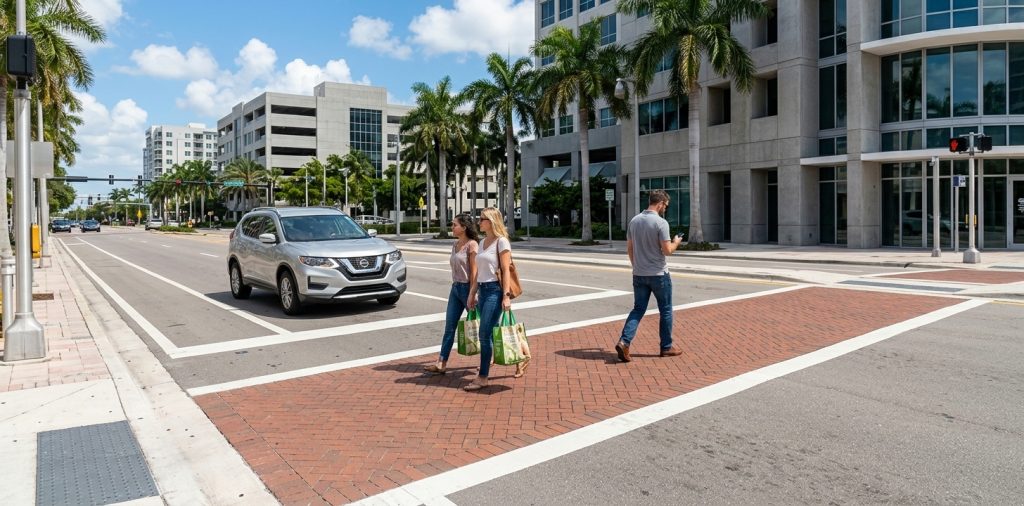
When a Vehicle Strikes a Pedestrian, the Consequences Are Devastating. We Help Victims and Families Pursue Justice.
When a vehicle strikes a pedestrian, the consequences are devastating. Pedestrians have no protection against a multi-ton vehicle traveling at speed. The injuries are often catastrophic — traumatic brain injuries, spinal cord damage, multiple fractures, internal organ damage — and the medical bills can be overwhelming.
At Florida Advocates, we represent pedestrians who have been struck by negligent drivers throughout Broward County, Fort Lauderdale, and all of Florida. We investigate the accident, preserve critical evidence, document your injuries, and pursue full compensation for your medical bills, lost wages, pain and suffering, and long-term care needs.
Carlos D. Cabrera spent years as insurance defense counsel before becoming a trial lawyer. He knows how insurers minimize pedestrian claims and builds counter-evidence from day one.
Florida Pedestrian Accident Statistics — The Most Dangerous State for Pedestrians
Florida is the most dangerous state in the nation for pedestrians. The combination of high traffic volumes, wide multi-lane roads, inadequate sidewalks, year-round outdoor activity, and tourist drivers unfamiliar with local conditions makes Florida exceptionally dangerous for people on foot.
| 9,513 Florida pedestrian crashes (2023) | 8,034 Pedestrians injured (2023) | 843 Pedestrian fatalities (2023) | 1,112 Broward County pedestrian crashes (2023) |
Source: Florida Department of Highway Safety and Motor Vehicles (FLHSMV)
Broward County recorded 1,112 pedestrian crashes in 2023, with 62 fatalities — one of the highest pedestrian death tolls in the state.
Common Causes of Pedestrian Accidents in Florida
Distracted driving
Drivers texting, talking on phones, adjusting GPS, or otherwise not watching the road.
Failure to yield at crosswalks
Drivers not stopping for pedestrians in marked or unmarked crosswalks, as required by Florida law.
Speeding
Higher speeds mean less reaction time and more severe impacts. A pedestrian struck at 40 mph has only a 15% chance of survival. At 20 mph, survival is 95%.
Turning vehicles
Drivers turning left or right without checking for pedestrians in crosswalks.
Backing vehicles
Drivers backing out of driveways or parking spaces without checking for pedestrians. Particularly dangerous for children.
Drunk or impaired driving
Drivers under the influence with impaired judgment and reaction times.
Running red lights and stop signs
Drivers entering intersections when pedestrians have the right of way.
Poor visibility
Accidents at night, in bad weather, or in areas with inadequate lighting or crosswalk markings.
Insurance companies often argue that pedestrians “came out of nowhere” or “stepped into traffic.” These are blame-shifting tactics. Drivers have a duty to watch for pedestrians and avoid collisions. We counter these arguments with evidence.
Common Pedestrian Accident Injuries
Pedestrian accidents typically result in severe injuries because the human body absorbs the full force of impact:
- Traumatic brain injuries (TBI) — The leading cause of pedestrian death and disability
- Spinal cord injuries and paralysis — Impact with vehicles or the ground can damage the spine
- Multiple bone fractures — Legs, pelvis, ribs, arms, and skull fractures
- Internal organ damage — Liver, spleen, kidney, and lung injuries from blunt force trauma
- Pelvic and hip fractures — Common from the height of vehicle bumpers
- Knee and leg injuries — Ligament tears, compound fractures, and crush injuries
- Facial injuries and disfigurement — Facial fractures, lacerations, and dental trauma
- Psychological trauma and PTSD — Long-lasting emotional effects from the accident
- Wrongful death — 843 Florida pedestrians died in 2023
Florida Pedestrian Right-of-Way Laws
Under Florida Statute 316.130, drivers must yield the right-of-way to pedestrians in crosswalks. Key provisions:
- Drivers must stop and remain stopped for pedestrians crossing in marked or unmarked crosswalks
- Drivers making turns must yield to pedestrians in the intersection
- Drivers exiting driveways or parking lots must yield to pedestrians on sidewalks
- Drivers must exercise due care to avoid colliding with pedestrians, regardless of who has right-of-way
Even if you were outside a crosswalk, the driver may still be liable. Drivers have a duty to exercise due care and avoid collisions with pedestrians at all times — not just at crosswalks.
Pedestrian Accidents Involving Children
Children are particularly vulnerable as pedestrians because they:
- Are smaller and less visible to drivers
- May not understand traffic rules or signals
- Can be unpredictable in their movements
- May enter the street suddenly while playing
- Are often struck in residential areas, school zones, and parking lots
Drivers have a heightened duty of care in areas where children are likely to be present, including school zones, parks, playgrounds, residential neighborhoods, and parking lots.
We hold negligent drivers accountable when children are injured. If your child was injured as a pedestrian, contact us immediately.
What Insurance Companies Do After a Florida Pedestrian Accident
When you file a claim after a pedestrian accident, the driver’s insurance company will work to minimize what they pay:
Blaming the pedestrian
Claiming you were jaywalking, wearing dark clothing, not paying attention, or “came out of nowhere”
Disputing right-of-way
Arguing you did not have the right of way even when you did
Arguing contributory negligence
Claiming you share fault to reduce the settlement
Disputing injury severity
Arguing injuries are minor, pre-existing, or unrelated to the accident
Offering quick settlements
Before you understand the full extent of catastrophic injuries
Requesting recorded statements
While you are hospitalized or in pain
Sending investigators to your home
Attempting to gather evidence against you
Surveilling your social media
Looking for photos or posts that contradict your injury claims
Do not post about your accident on social media. Do not accept quick settlement offers. Contact Florida Advocates immediately.
What to Do After a Pedestrian Accident in Florida
Call 911
Request police and emergency medical services immediately. Do not refuse ambulance transport — injuries may be more severe than you realize.
Stay at the scene
If you are able, do not leave until police arrive.
Accept medical transport
Do not refuse ambulance transport. Pedestrian injuries are often more severe than they initially appear.
Document if possible
If you are able (or have someone help you), take photos of the scene, the vehicle, and your visible injuries.
Get driver and witness information
Obtain driver’s license, insurance, license plate, and contact information. Get names and numbers for witnesses.
Note surveillance cameras
Look for traffic cameras and nearby business security cameras that may have captured the accident.
Do not give recorded statements
Do not speak with the driver’s insurance company without an attorney.
See a doctor within 14 days
This preserves your PIP benefits and documents your injuries.
Contact Florida Advocates immediately
We send preservation letters for traffic camera footage and surveillance before it is deleted (typically 24-72 hours).
The 14-Day Rule for Pedestrian Accidents
If you were injured as a pedestrian in Florida, you must seek medical treatment within 14 days to preserve your PIP benefits. This deadline is absolute.
Florida’s 14-day rule applies to pedestrian accidents involving motor vehicles. Under Florida Statute 627.736, you must receive initial medical treatment within 14 days of the accident to qualify for PIP benefits.
Given the severity of most pedestrian accident injuries, immediate medical care is typically necessary. However, if you declined ambulance transport at the scene and symptoms developed later, the 14-day deadline still applies.
Why Carlos D. Cabrera Handles Pedestrian Accident Cases Differently

Pedestrian accident cases often involve catastrophic injuries requiring extensive medical documentation and life care planning. Carlos D. Cabrera’s background as insurance defense counsel gives him insight into how insurers evaluate these claims and attempt to minimize payouts.
Before becoming an attorney, Carlos worked as insurance defense counsel. He evaluated claims, reviewed medical records, and developed the arguments insurers use to minimize payouts. Now he uses that inside knowledge to pursue full compensation for pedestrians.
We build comprehensive cases that document the full extent of your injuries and pursue maximum compensation for current and future needs.
Learn more about Carlos D. Cabrera →
About Lawyer Carlos D. Cabrera
Carlos D. Cabrera leads the Personal Injury Department at Florida Advocates. Before becoming a lawyer, Carlos worked as insurance defense counsel.
Education
- J.D. — St. Thomas University College of Law (2000)
- Managing Editor, St. Thomas Law Review
- B.A. English — Florida International University (1994)
Bar Admissions
- The Florida Bar
- U.S. District Court, Southern District of Florida
- U.S. District Court, Middle District of Florida
- U.S. District Court, Northern District of Florida
Carlos’s federal court admissions mean he can handle complex cases that cross state lines or involve federal questions — not just state court claims.
Credentials & Recognitions
- Million Dollar Advocates Forum Member
- Multi-Million Dollar Advocates Forum Member
- Florida Legal Elite Recognition
- Lead Counsel Verified (Appellate, since 2015)
- Former Insurance Defense Counsel
Learn more about Carlos D. Cabrera →
Frequently Asked Questions — Florida Pedestrian Accidents
Can I recover if I was jaywalking?
Possibly. Florida’s comparative negligence law allows partial recovery even if you were partially at fault. The driver may still bear significant responsibility for failing to avoid the accident.
What if the driver did not stop (hit and run)?
You can pursue your own UM/UIM coverage. We also investigate to identify the driver through witnesses, traffic cameras, and other evidence.
Who pays my medical bills after a pedestrian accident?
Your own PIP coverage pays first (up to $10,000 at 80%). Beyond that, the at-fault driver’s insurance or your UM/UIM coverage may apply.
How long do pedestrian accident cases take?
Cases involving serious injuries often take 1-2 years to resolve because we need to understand the full extent of your injuries and future care needs before settling.
What does it cost to hire Florida Advocates?
Nothing unless we recover for you. We work on a contingency fee basis and advance all costs.
Florida Pedestrian Accident Local Resources
HOSPITALS AND TRAUMA CENTERS (Broward County)
Broward Health Medical Center (Level I Trauma Center)
1600 S Andrews Avenue, Fort Lauderdale, FL 33316
Phone: (954) 355-4400
Memorial Regional Hospital (Level I Trauma Center)
3501 Johnson Street, Hollywood, FL 33021
Phone: (954) 987-2000
COURTS
Broward County Courthouse (17th Judicial Circuit)
201 SE 6th Street, Fort Lauderdale, FL 33301
Phone: (954) 831-6565
Serving Pedestrian Accident Clients Throughout South Florida
Fort Lauderdale | Dania Beach | Hollywood | Pembroke Pines | Coral Springs | Plantation | Hallandale Beach | Miramar | Weston | Pompano Beach | Boca Raton | Miami | Miami Beach | Hialeah | North Miami | Tampa
Contact a Florida Pedestrian Accident Lawyer
If you or a loved one has been struck by a vehicle while walking, contact Florida Advocates today for a free consultation.
Phone: 754-290-3803
Email: info@fladvocates.com
After all, isn’t that what family would do?
Related Practice Areas
Bicycle Accident Lawyer
Car Accident Lawyer
Brain Injury Lawyer
Wrongful Death Lawyer
Catastrophic Injury Lawyer
UM/UIM Coverage Lawyer
Contact Us
Fill out the contact form or call us at 754-290-3803 to schedule your free consultation. Free Consultation
  Available 24/7
  No Fees Unless You Win