
Your Story Matters.
Your Family Matters.
Your Results Matter.
Your Family Matters.
Your Results Matter.


You pay your insurance premiums every month. When you file a claim, you expect your insurance company to honor their end of the contract. But too often, insurers unreasonably deny valid claims, delay payments, or offer far less than your claim is worth. When they do, it is not just frustrating. It may be illegal.
Florida law protects policyholders from insurance company bad faith. At Florida Advocates, we hold insurers accountable when they fail to act in good faith, and we pursue the full compensation you are owed, which in some cases includes damages beyond your original policy limits.
Insurance bad faith occurs when an insurance company fails to fulfill its legal duty to act fairly and honestly with policyholders. Under Florida Statute 624.155, insurers must handle claims in good faith. When they do not, policyholders have the right to sue for damages.
Bad faith can occur with any type of insurance: auto, homeowners, health, disability, or liability policies. The insurer may be your own company (first-party bad faith) or the at-fault party’s insurer (third-party bad faith).
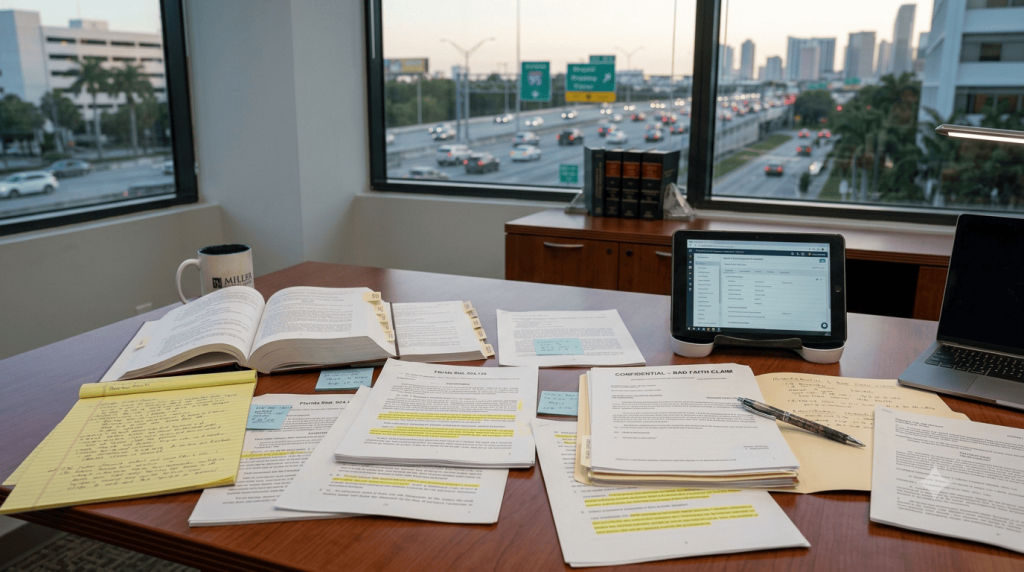
Florida Statute 624.155 allows policyholders to bring a civil action against insurers who act in bad faith. Before filing suit, you must file a Civil Remedy Notice (CRN) with the Florida Department of Financial Services, giving the insurer 60 days to cure the violation.
If the insurer fails to cure within 60 days, you may proceed with a bad faith lawsuit. If successful, you may recover damages beyond your policy limits, including consequential damages, attorney fees, and in some cases, punitive damages.
First-party bad faith: When your own insurance company acts in bad faith on your claim. For example, your auto insurer denying your UM/UIM claim or your homeowner’s insurer delaying your hurricane damage claim.
Third-party bad faith: When the at-fault party’s insurer fails to settle within policy limits when they should have, exposing their insured to excess judgment. This typically arises in personal injury cases where the liable party’s insurer refuses reasonable settlement demands.
Christopher M. Tuccitto, CEO and Managing Partner of Florida Advocates, has spent more than 25 years investigating insurance coverage issues and drafting lawsuits and demands against insurance carriers. Each year he reviews thousands of insurance files for coverage and potential litigation. He knows how insurance companies evaluate claims, what tactics they use, and how to counter them.
He is also a contributing author of Florida Motor Vehicle No-Fault Law (P.I.P.), a nationally distributed reference published by West Group, and he began his career with a law clerkship in the company regulation section of the Florida Department of Insurance.
When an insurer may have acted in bad faith, Christopher M. Tuccitto knows how to examine the claim file, document the violations, and build a case that holds the insurer accountable.
In a successful bad faith claim, you may recover the full value of your original claim plus additional damages caused by the insurer’s conduct. This may include interest, emotional distress, consequential damages (such as foreclosure or bankruptcy caused by the delay), attorney fees, and in egregious cases, punitive damages designed to punish the insurer and deter future misconduct.

Christopher M. Tuccitto is the CEO and Managing Partner of Florida Advocates. He began his career with the firm shortly after its founding in 1998 and heads up its insurance investigation and litigation filing. He has 25+ years of experience.
Education
Bar Admission
Credentials & Recognitions
Learn more about Christopher M. Tuccitto →
Insurance bad faith occurs when an insurer unreasonably denies, delays, or undervalues a valid claim, or fails to investigate properly. Florida law allows policyholders to sue for damages when this happens.
You must file a Civil Remedy Notice within the statute of limitations for your underlying claim. Consult an attorney promptly to preserve your rights.
Yes. In a successful bad faith claim, you may recover damages beyond policy limits, including consequential damages, attorney fees, and potentially punitive damages.
While not required, bad faith claims involve complex legal procedures including the Civil Remedy Notice requirement. An experienced attorney can navigate these requirements and maximize your recovery.
We work on a contingency fee basis:
You will never receive a bill from us while your case is active.
Dania Beach (Broward County) — Headquarters
45 E Sheridan Street Dania Beach, FL 33004
North Miami (Miami-Dade County)
13499 Biscayne Blvd #107 North Miami, FL 33181
Tampa (Hillsborough County)
238 E Davis Blvd #210 Tampa, FL 33606
Phone: 754-290-3803
Email: info@fladvocates.com
Hours: Monday – Friday: 9:00 AM – 5:00 PM
Available by phone 24/7 for emergencies
If your insurance company has denied, delayed, or undervalued your claim, do not wait. Florida’s bad faith process has strict deadlines — the Civil Remedy Notice must be filed within the statute of limitations for your underlying claim, and the 60-day cure window starts the moment the notice is served. Evidence of bad faith conduct, including internal claim notes and adjuster communications, can disappear. Contact Florida Advocates today to protect your rights and hold your insurer accountable.
Call: 754-290-3803
Email: info@fladvocates.com
Call us for a free consultation. You pay nothing unless we recover for you. After all, isn’t that what family would do?
 Free Consultation
 Available 24/7
 No Fees Unless You Win