
Your Story Matters.
Your Family Matters.
Your Results Matter.
Your Family Matters.
Your Results Matter.


When Property Owners Fail to Maintain Safe Conditions, People Get Hurt. We Hold Them Accountable.
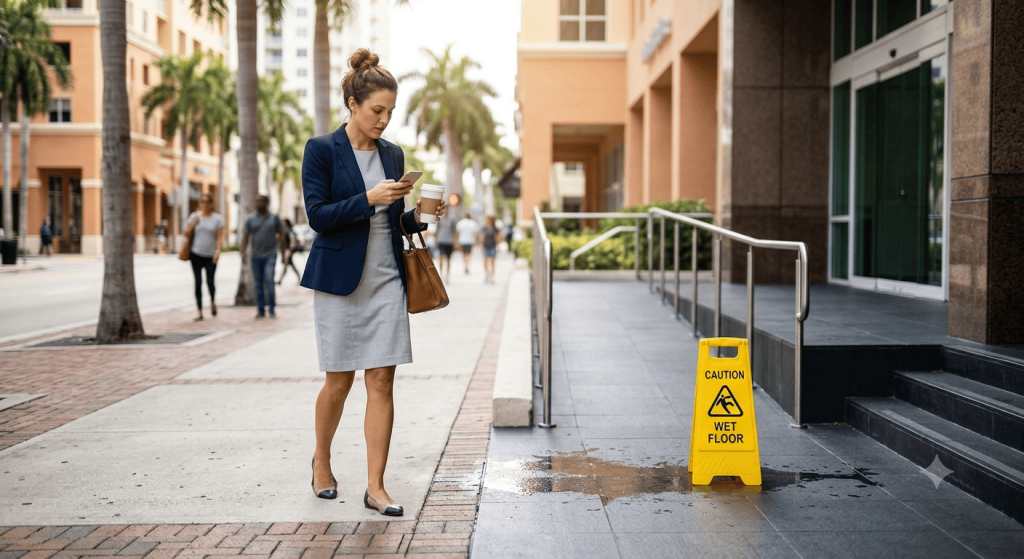
Florida Advocates represents injury victims throughout Broward County, Fort Lauderdale, and South Florida who have been hurt because of a property owner’s failure to maintain safe conditions. From slip and falls in grocery stores to negligent security in apartment complexes, swimming pool accidents, dog bites, and falling objects in retail stores — premises liability cases require an Lawyer who knows exactly how to prove the property owner knew or should have known about the danger.
Christopher M. Tuccitto has more than 25 years of legal experience in insurance investigation and litigation. He knows from the inside exactly how property owner insurers defend these claims — and he begins building the counter-evidence from day one.
A client vacationing in Florida was injured at a boat show and needed immediate legal guidance before flying home to the Northeast. After unsuccessfully reaching out to other Lawyers, the client contacted our office late in the day with an early-morning flight scheduled for the next morning.
Rather than delegating or postponing, Christopher M. Tuccitto handled the intake personally — traveling directly to the resort where the client was staying. They met in person, reviewed the circumstances, and Christopher personally interviewed a witness who had seen what happened. Although it was their only in-person meeting, establishing trust and understanding the facts firsthand allowed the case to move forward efficiently.
The matter resolved without litigation for a high six-figure settlement — demonstrating that attentive, hands-on representation at the outset can make a decisive difference in the outcome.
High six-figure settlement
Premises injury at a boat show. Out-of-state client. Other Lawyers unresponsive. Christopher met the client in person within hours and secured a substantial recovery without litigation.
Past results do not guarantee future outcomes. Every case is evaluated on its individual facts.
Property-related injuries are among the most common causes of emergency room visits in Florida. According to the National Floor Safety Institute and CDC:
| Statistic | Number |
|---|---|
| Annual U.S. emergency room visits from slip and falls | 1 million+ |
| Falls as cause of workers’ compensation claims | #1 leading cause |
| Florida ranking for child drowning deaths | #1 in the nation |
| Premises liability statute of limitations (Florida) | 2 years |
In Florida, the combination of year-round wet weather, high tourist traffic, aging commercial properties, and a large senior population creates conditions where premises injuries are especially common. Broward County’s shopping centers, hotels, apartment complexes, restaurants, and entertainment venues see thousands of preventable injuries each year.
Beyond slip and falls, Florida property owners face liability for negligent security, swimming pool accidents, dog bites, elevator malfunctions, and dangerous conditions in parking structures. When property owners fail to maintain safe conditions, they should be held accountable.

Most personal injury Lawyers have only ever worked one side of a premises liability claim — the plaintiff’s side. Christopher M. Tuccitto worked on both sides before he ever set foot in a courtroom as a trial Lawyer.
Christopher Tuccitto earned his J.D. from the University of Florida Levin College of Law in 1997. He evaluated premises claims, reviewed surveillance footage, analyzed maintenance records, and developed the arguments that insurers use to deny or minimize these cases. He was selected as the designated adjuster for his company’s largest insured, managing complex claims under specialized handling procedures. He was then recruited by the state’s largest personal injury firm — which is where he decided to pursue his law degree to do that work herself.
When Christopher takes on your premises liability case, she is not guessing what the insurance company is going to argue. She already knows. And she begins gathering the evidence that defeats their strategy from day one — including the immediate preservation letter that protects surveillance footage, maintenance records, and incident reports before they get destroyed in the ordinary course of business.
Learn more about Christopher M. Tuccitto →
Florida law requires property owners, managers, and occupiers to maintain reasonably safe conditions for the people who enter their premises. The duty owed depends on the visitor’s legal status:
Customers in a store, guests at a hotel, patients at a medical office, diners at a restaurant — anyone who enters property for a purpose for which it is held open to the public. Property owners owe invitees the highest duty of care: regular inspection, identification of hazards, and prompt correction or adequate warning. Most Broward County premises liability cases involve invitees.
Social guests — someone you invite to your home, for example. Property owners must warn licensees of known dangers the visitor would not reasonably discover on their own. The duty is lower than for invitees but still meaningful.
Even trespassers carry some legal protections under Florida law. Property owners may not willfully or wantonly harm trespassers. For children — particularly in swimming pool cases under Florida’s attractive nuisance doctrine — significantly stronger protections apply. Property owners must take reasonable steps to prevent foreseeable harm to child trespassers attracted by dangerous conditions like unfenced pools.
Insurers often argue that an injured visitor was a “licensee” or “trespasser” rather than an “invitee” to reduce the duty owed and minimize the claim. Establishing the correct visitor status is one of the first strategic moves we make in any premises liability case.
Property owners carry liability insurance for exactly these situations. But when a claim is filed, the insurer’s goal is to pay as little as possible. Common tactics we see in Broward County premises liability claims include:
The moment you retain Florida Advocates, all communication with the insurance company goes through us. We send preservation letters immediately to protect surveillance footage, maintenance records, and incident reports. You will not be pressured or misled. We handle the insurer while you focus on your recovery.
The most common form of premises liability. Florida Statute Section 768.0755 governs slip and fall cases in business establishments involving transitory foreign substances — liquids, food, debris. We also handle falls caused by broken flooring, uneven surfaces, defective stairs, missing handrails, and inadequate lighting. We know exactly how to preserve the surveillance footage and maintenance records needed to prove the case.
Learn more about slip and fall claims →
When an assault, robbery, rape, or violent crime occurs on commercial property — a parking garage, hotel, apartment complex, convenience store, or nightclub — and the crime was foreseeable based on the property’s location and history, the property owner may be liable for failing to provide adequate security.
Negligent security cases require analyzing prior incidents on and near the property, adequacy of lighting, presence and functionality of cameras, quality of locks and access controls, and whether trained security personnel were present. South Florida properties with known crime histories face heightened duties to protect visitors.
Florida requires strict pool fencing, barriers, alarms, and safety equipment standards under the Residential Swimming Pool Safety Act. When a child is injured or drowns because a property owner failed to meet these requirements, both civil liability and criminal exposure can result.
Florida leads the nation in child drowning deaths. Pool cases are highly time-sensitive — physical evidence, maintenance records, gate functionality, and witness recollections must be preserved immediately.
Building owners and management companies have a duty to ensure elevators and escalators are properly maintained, inspected, and repaired promptly. Sudden drops, door malfunctions, uneven landings, and entrapment all fall within premises liability. Florida law requires regular inspections, and inspection records can be critical evidence.
Merchandise falling from store shelves, construction materials from scaffolding, improperly secured signage, or debris from balconies — when a falling object causes injury because a property owner, retailer, or contractor failed to secure it properly, a premises liability claim may exist.
Poorly lit garages, crumbling pavement, potholes, unmarked speed bumps, inadequate pedestrian markings, and lack of security create dangerous conditions for customers. Florida property owners have a duty to maintain parking areas to a reasonably safe standard — and that includes security in high-crime areas.
Florida Statute Section 767.04 imposes strict liability on dog owners for bites that occur in public or on private property when the victim was lawfully present. Unlike many states, Florida does not give dogs a “first bite free” — the owner is liable even if the dog has never bitten anyone before.
Dog bite cases are handled as part of our premises liability and personal injury practice throughout South Florida.
Apartment complexes, condominiums, and HOA-managed communities must maintain common areas — hallways, staircases, parking structures, pool areas, fitness centers, and playgrounds — in reasonably safe condition. When defective conditions in common areas cause injury, the property owner, management company, or HOA may be liable.
The knowledge element is most often disputed
Property owners routinely deny awareness of a hazard. Our work involves gathering surveillance footage, maintenance logs, inspection records, prior incident reports, employee testimony, and expert analysis to demonstrate the dangerous condition existed long enough that a reasonably diligent owner would have discovered and corrected it.
Request a copy of the incident report before leaving the property. Do NOT sign anything — many “incident reports” contain hidden liability waivers or releases.
Florida follows a modified comparative negligence rule under Florida Statute § 768.81, revised in March 2023:
Property owners’ insurers routinely argue that the injured person was partially responsible. Common arguments include:
Example: If your damages are $200,000 and the insurer convinces a jury you were 25% at fault, you recover $150,000. If they convince a jury you were 51% at fault, you recover nothing.
We anticipate these arguments from the start and build the evidence that defeats them. Even if you bear some responsibility, you may still be entitled to significant compensation. Christopher’s experience as a experienced insurance litigation attorney means she knows exactly how comparative fault arguments are constructed — and exactly how to dismantle them.
Two years from the date of injury for most claims. Special rules apply to government property — pre-suit notice within 3 years and damage caps under Florida’s sovereign immunity law.
Florida law gives you two years from the date of injury to file a premises liability lawsuit. If the property is owned by a government entity — city, county, or state — you must file a formal pre-suit notice within three years under Florida Statute § 768.28, and damage caps of $200,000 per person and $300,000 per incident apply.
Special deadlines apply when:
The bigger practical deadline is the evidence deadline. Surveillance footage, maintenance logs, and incident reports may be discarded within days or weeks. Contact us as early as possible to preserve the evidence that proves your case.
Christopher Michael Tuccitto is the CEO and Managing Partner of Florida Advocates and has more than 25 years of legal experience. He joined the firm shortly after its founding in 1998 and became a partner in 2019. His work includes insurance investigation and litigation, reviewing insurance files for coverage and potential litigation, investigating coverage issues, and preparing lawsuits and demands against insurers.
Christopher earned his J.D. from the University of Florida Levin College of Law in 1997 and his B.A. in Political Science with Honors from the University of Florida in 1993, where he was a member of Phi Beta Kappa. He was admitted to The Florida Bar in 1999 (Bar No. 168297).
He serves as Vice President and a board member of the South Broward Bar Association and previously served as President of the North Dade Bar Association from 2007 to 2008. He is a contributing author of Florida Motor Vehicle No-Fault Law (P.I.P.), nationally distributed by West Group. Our City Hollywood Magazine recognized him as Best Insurance Attorney in Hollywood in 2023, 2024, and 2025.
Education
Bar Admission
Professional Memberships and Service
Learn more about Christopher M. Tuccitto →
Premises liability is the area of law that holds property owners, managers, and occupiers responsible when dangerous conditions on their property cause injury to visitors. It covers slip and falls, negligent security, swimming pool accidents, dog bites, elevator injuries, falling objects, and any other injury caused by unsafe property conditions.
Waivers are not always enforceable under Florida law. Waivers attempting to release liability for gross negligence or intentional acts are generally invalid. Even waivers covering ordinary negligence may be challenged if they are ambiguous, hidden in fine print, or violate public policy. Do not assume a waiver ends your case — let us evaluate it.
Yes. Landlords in Florida have premises liability exposure for common areas of rental properties — hallways, staircases, parking areas, lobbies, elevators, and shared amenities like pools and fitness centers. If a defective common-area condition caused your injury and the landlord knew or should have known about it, a claim may be viable.
Construction sites present complex multi-party liability considerations. Depending on who controlled the worksite and the specific hazard, liability may fall on the general contractor, a subcontractor, the property owner, equipment manufacturers, or a combination. These cases require prompt investigation to identify all responsible parties and preserve critical evidence.
Under Florida’s modified comparative negligence rule, you can recover compensation as long as you were not more than 50% at fault. Your recovery is reduced by your percentage of fault. For example, if your damages are $200,000 and you are found 25% at fault, you recover $150,000. Countering blame-shifting arguments is a core part of what we do.
Premises liability cases typically resolve within 6 to 18 months depending on the complexity of proving knowledge, the severity of injuries, and the willingness of the insurer to negotiate fairly. Cases involving negligent security, swimming pool accidents, or multiple defendants may take longer. The key is preserving evidence from day one.
Most Florida premises liability cases resolve through negotiated settlement without going to trial. However, we prepare every case as if it will go to trial — because insurers settle for more when they know the opposing Lawyer is genuinely prepared to litigate.
Case value depends on injury severity, impact on your work and daily life, the property owner’s degree of fault, available insurance coverage, and the strength of the evidence proving knowledge. We provide a full case evaluation at no charge before any decisions are made.
Nothing unless we recover for you. We work on a contingency fee basis and advance all costs (filing fees, expert witnesses, medical records). You pay nothing unless we win your case.
Broward Health Medical Center
(Level I Trauma Center — Adult & Pediatric) 1600 S Andrews Avenue, Fort Lauderdale, FL 33316
Phone: (954) 355-4400
Website
Memorial Regional Hospital
(Level I Trauma Center) 3501 Johnson Street, Hollywood, FL 33021
Phone: (954) 987-2000
Holy Cross Hospital
4725 N Federal Highway, Fort Lauderdale, FL 33308
Phone: (954) 771-8000
Broward County Courthouse (17th Judicial Circuit)
201 SE 6th Street, Fort Lauderdale, FL 33301
Phone: (954) 831-6565
Website
You may have seen billboards, TV commercials, and online ads promising fast settlements. Many of these are “settlement mills” — high-volume firms that push for fast settlements rather than maximum recovery. Premises liability cases are particularly poorly served by this approach because they require methodical evidence-gathering and strategic legal analysis.
At Florida Advocates, we take a different approach:
You deserve more than a billboard. You deserve an advocate who will actually pursue your full recovery.
We work on a contingency fee basis. That means:
You will never receive a bill from us while your case is active. We only get paid when you do.
Florida Advocates is a personal injury law firm headquartered in Dania Beach, Florida — in the heart of Broward County. We represent premises liability victims throughout Fort Lauderdale, Broward County, and all of Florida.
Office Locations:
Dania Beach (Broward County) — Headquarters
45 E Sheridan Street Dania Beach, FL 33004
North Miami (Miami-Dade County)
13499 Biscayne Blvd #107 North Miami, FL 33181
Tampa (Hillsborough County)
238 E Davis Blvd #210 Tampa, FL 33606
Phone: 754-290-3803
Email: info@fladvocates.com
Hours: Monday – Friday: 9:00 AM – 5:00 PM
Available by phone 24/7 for emergencies
Florida Advocates represents clients injured on commercial, residential, and government-owned properties throughout Broward County, Miami-Dade County, Palm Beach County, and Hillsborough County, including:
If you were injured on a property anywhere in Florida, we can help.
If you or a loved one has been injured on someone else’s property anywhere in Florida, contact Florida Advocates today for a free, confidential consultation. Time matters — surveillance footage and maintenance records may be destroyed within days. Call now to protect the evidence that proves your case.
Phone: 754-263-4252
Email: info@fladvocates.com
Call us for a free consultation. You pay nothing unless we recover for you. After all, isn’t that what family would do?
If your premises injury involved:
 Free Consultation
 Available 24/7
 No Fees Unless You Win