
Your Story Matters. Your Family Matters. Your Results Matter.


Awards and recognitions listed are not indicative of future results. Selection criteria vary by organization.
Fort Lauderdale Pedestrian Accident Lawyer
Fort Lauderdale Pedestrian Accident Lawyer
Florida Is the Deadliest State in the Nation for Pedestrians. When Drivers Fail to Yield, Fail to Look, or Flee the Scene, We Prove What Really Happened.
Florida Advocates represents pedestrian accident victims throughout Fort Lauderdale, Hollywood, Pompano Beach, and Broward County. When you are hit by a car on A1A, US-1, Las Olas Boulevard, Sunrise Boulevard, or any street in Broward County — whether you were in a crosswalk, on a sidewalk, in a parking lot, or crossing the street — the bias often starts immediately. Drivers blame pedestrians. Police reports reflect driver versions. Insurance adjusters assume you were at fault until proven otherwise.
We know better. Carlos D. Cabrera was insurance defense counsel before he became a trial lawyer. He knows exactly how insurers defend against pedestrian claims — because he helped write the playbook. Now he defeats it.
Florida Pedestrian Statistics — A Public Safety Crisis
According to the Florida Department of Highway Safety and Motor Vehicles and federal data:
| Statistic | Approximate Annual Figure |
|---|---|
| Florida pedestrian crashes (2023) | 9,200+ |
| Florida pedestrian injuries (2023) | 7,400+ |
| Florida pedestrian fatalities (2023) | 800+ |
| Florida’s national rank for pedestrian fatality rate | Consistently #1 |
Florida has been ranked the most dangerous state in the nation for pedestrians for years. Smart Growth America’s “Dangerous by Design” report has consistently placed Florida at the top of the rankings — and South Florida metro areas, including Fort Lauderdale-Pompano Beach-Hollywood, regularly appear in the top five most dangerous metropolitan areas in the country.
Broward County recorded approximately 1,112 pedestrian crashes and 62 pedestrian fatalities in 2023. The risk factors are concentrated in:
- A1A coastal corridor — heavy tourist traffic, beachgoers crossing, drivers distracted by scenery
- US-1 (Federal Highway) — high-speed arterial with frequent driveway and intersection conflicts
- Las Olas Boulevard — downtown Fort Lauderdale’s pedestrian-heavy corridor
- Hollywood Boulevard and Hollywood Broadwalk — significant pedestrian traffic mixed with vehicle traffic
- Tourist-heavy areas — Fort Lauderdale Beach, Las Olas, Hollywood Beach, Pompano Beach Pier
- School zones and bus stops — children walking to and from schools
- Senior communities — pedestrians with reduced mobility crossing major arterials
- Year-round walking weather — no winter slowdown means crash exposure stays high
- Limited pedestrian infrastructure — many South Florida arterials are designed for cars, not walkers
The reality is harsh: a pedestrian hit by a car has no protection. No frame, no airbags, no crumple zones. When a driver fails to yield at a crosswalk, fails to look while turning, or fails to see a pedestrian crossing the street, the injuries are often catastrophic — and frequently fatal.
Florida Pedestrian Law — What Drivers and Insurers Don’t Want You to Know
Drivers Must Yield to Pedestrians in Crosswalks
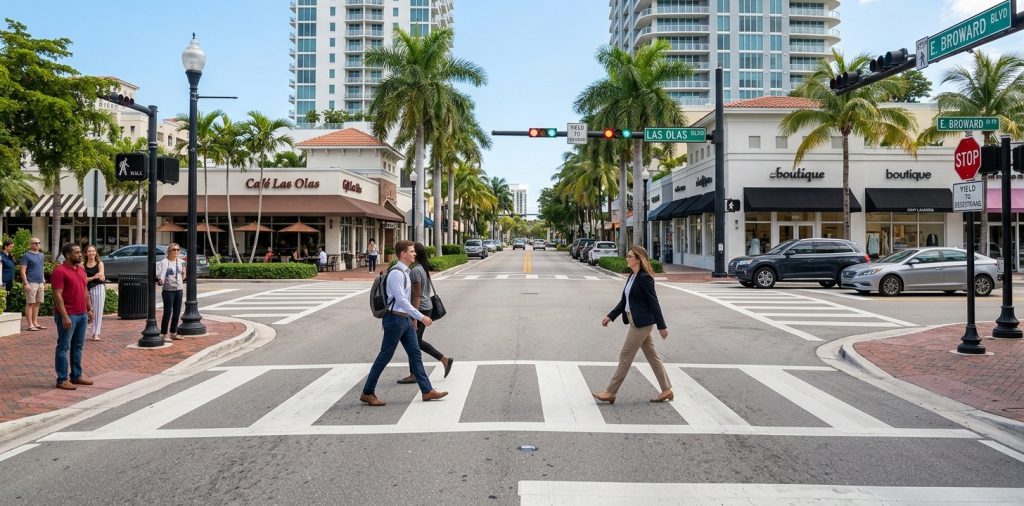
Under Florida Statute § 316.130, drivers must yield the right of way to pedestrians in marked crosswalks and at intersections. This is one of the most basic — and most violated — duties on Florida roads.
When a driver fails to yield and strikes a pedestrian in a crosswalk, the failure-to-yield violation is strong evidence of negligence. We obtain:
- Dashcam footage from the driver’s vehicle, nearby vehicles, and rideshare cars
- Surveillance footage from businesses, traffic cameras, and red-light cameras
- Witness statements from other drivers, pedestrians, and bystanders
- Crosswalk markings and signage documentation at the scene
- Phone records and texting logs when distracted driving is suspected
Pedestrian Duties Under Florida Law
Florida law also imposes duties on pedestrians:
- Use sidewalks where available — when sidewalks are present, pedestrians must use them rather than walking in the road
- Walk facing traffic when no sidewalk exists — pedestrians walking on roadways must walk on the left side of the roadway, facing oncoming traffic
- Yield to vehicles outside crosswalks — pedestrians crossing outside crosswalks must yield to vehicles
- Obey pedestrian signals — at signalized intersections, pedestrians must obey “Walk” / “Don’t Walk” signals
But these duties do not eliminate driver duties. A pedestrian crossing outside a crosswalk does not absolve the driver of the duty to keep a proper lookout, drive at a safe speed, and avoid hitting people who are visible.
Children and the Special Standard
Florida applies special standards to child pedestrian cases:
- Children under 6 are generally not held to any comparative negligence standard
- Children 6 to 14 are held only to the standard reasonable for a child of similar age, intelligence, and experience
- Drivers in school zones and residential areas owe heightened duties of care
- Crosswalk guards and school crossing zones create special legal protections
When a child is injured as a pedestrian, the legal analysis is dramatically different from an adult case. We handle child pedestrian cases with the special protections Florida law provides.
Modified Comparative Negligence — Effective March 2023
Florida’s modified comparative negligence rule under Florida Statute § 768.81, revised in March 2023:
- If you are partially at fault below 50%, your recovery is reduced by your percentage of fault
- If you are more than 50% at fault, you cannot recover any damages
Insurers aggressively push fault onto pedestrians for:
- Crossing outside a crosswalk
- Crossing against the signal
- Walking in the road when a sidewalk was available
- Wearing dark clothing at night
- Distraction (looking at a phone)
- Whether the pedestrian “should have seen” the vehicle
Building the evidence that defeats these arguments is core to how we handle pedestrian accident cases.
Statute of Limitations — Two Years
Two years from the date of the accident to file a personal injury lawsuit. Missing this deadline permanently eliminates your right to compensation.
Surveillance footage from intersections, businesses, and traffic cameras may be deleted within days. Witness recollections fade. Physical evidence is repaired or discarded. Contact us as early as possible.
The Most Common Pedestrian Accident Patterns
Crosswalk Crashes — Failure to Yield
A driver fails to yield to a pedestrian in a marked crosswalk. This is the most clear-cut form of driver negligence — and one of the most common pedestrian accident patterns. Failure-to-yield citations and witness statements often establish liability.
Left-Turn Crashes
A driver turning left across an intersection fails to see a pedestrian crossing in the crosswalk. The driver is focused on oncoming vehicle traffic and misses the pedestrian. These crashes often happen in midblock crosswalks or at signaled intersections.
Right-Turn-on-Red Crashes
A driver turning right on red fails to look both directions before turning, striking a pedestrian crossing with the signal. Florida allows right-on-red after a complete stop, but the driver still owes a duty to yield to pedestrians in the crosswalk.
Back-Up Incidents in Parking Lots
Drivers backing out of parking spaces fail to look behind them and strike pedestrians. Modern back-up cameras and proximity sensors do not eliminate the driver’s duty to look. Parking lot surveillance footage is critical evidence — and frequently overwritten quickly.
Hit-and-Run Crashes
When a driver flees the scene, your own uninsured motorist (UM) coverage typically applies. We work with law enforcement and surveillance footage to identify the driver when possible — and pursue UM coverage when the driver cannot be identified.
Distracted Driving Crashes
Drivers texting, eating, or distracted by GPS strike pedestrians who were clearly visible. We obtain phone records and texting logs in cases where distracted driving is suspected.
Drinking and Driving Crashes
DUI crashes against pedestrians are particularly devastating. When alcohol or drugs are involved, additional claims may apply, including:
- Punitive damages under Florida Statute § 768.72
- Dram shop claims under Florida Statute § 768.125 against bars or restaurants that overserved the driver
School Zone Crashes
Children struck in school zones, at bus stops, or near schools. School zones impose additional speed limits and heightened driver duties. Crashes in school zones often involve both private liability and potential government entity claims.
Sidewalk Strikes and Driveway Crashes
Drivers leaving driveways, parking lots, or alleys strike pedestrians on sidewalks. Drivers exiting private property must yield to pedestrians on adjacent sidewalks.
Construction Zone Crashes
Inadequate pedestrian accommodations in construction zones — closed sidewalks, missing detour signs, debris — can support claims against the construction company, the contractor, or the government entity responsible for the work zone.
PIP Coverage for Pedestrians — A Benefit Most Don’t Know About
Here is something most pedestrians do not realize: if you own a car with PIP coverage, your auto PIP applies when you are hit by a motor vehicle while walking.
This is a significant benefit that many injured pedestrians fail to claim:
- 80% of reasonable medical expenses — up to $10,000 (or $2,500 if not classified as an emergency medical condition)
- 60% of lost wages
- $5,000 death benefits
If you do not own a car but a household relative does, that relative’s PIP policy may apply.
The 14-day rule still applies: You must seek medical treatment within 14 days of the accident to qualify for PIP benefits — even if your injuries seemed minor at the time.
The 14-Day Rule applies to pedestrian crashes. See a doctor within 14 days of being hit — even if you feel fine — or you forfeit your PIP benefits.
Learn more about PIP coverage →
What If the Driver Was Uninsured? UM/UIM for Pedestrians
If the driver who hit you had no insurance or insufficient insurance, your own auto UM/UIM coverage may apply — even though you were on foot when the crash happened.
UM/UIM coverage protects pedestrians when:
- The at-fault driver had no liability insurance (uninsured)
- The at-fault driver’s policy limits were too low to cover your damages (underinsured)
- The driver fled the scene and was never identified (hit-and-run)
This is one of the most overlooked sources of pedestrian recovery. Many people assume UM/UIM only applies when they are driving a car. It does not. Your auto UM/UIM coverage protects you on foot, on a bicycle, and in many other circumstances.
Learn more about UM/UIM and denied insurance claims →
Common Pedestrian Injuries
Pedestrian crashes produce some of the most catastrophic injuries we see. With no protection between the body and a multi-thousand-pound vehicle, pedestrians absorb the full force of impact and the secondary impact with pavement, vehicle parts, or other surfaces.
Traumatic Brain Injury (TBI)
The most common cause of death and disability in pedestrian crashes. The forces involved often produce concussions, contusions, intracranial bleeding, and severe traumatic brain injuries. Symptoms may not appear immediately.
Spinal Cord Injuries
Herniated discs, nerve damage, and partial or complete paralysis. Spinal injuries often require lifetime medical care, adaptive equipment, and home modifications.
Broken Bones and Fractures
- Fractured pelvis and hip — extremely common when a pedestrian is struck by a vehicle bumper
- Broken legs and femur fractures — bumper-level impact
- Broken arms, wrists, and shoulders (from bracing during the secondary impact with the ground)
- Skull fractures and facial fractures
- Rib fractures and sternum injuries (from vehicle hood impact)
Internal Organ Damage
The blunt force of vehicle impact can cause severe damage to the liver, spleen, kidneys, and other internal organs. Internal bleeding may not be immediately apparent and can be life-threatening.
Soft Tissue Injuries and Road Rash
When a pedestrian is thrown or dragged, friction with the pavement can cause severe road rash, requiring skin grafts and multiple surgeries.
Crush Injuries and Amputation
When a pedestrian is struck by a heavy vehicle or run over, crush injuries can be severe — sometimes requiring surgical amputation.
Psychological Injuries
- Post-traumatic stress disorder (PTSD)
- Anxiety and fear of walking near traffic
- Depression
- Sleep disturbances
Wrongful Death
Pedestrian crashes have the highest fatality rate of any crash type involving a pedestrian. When a pedestrian is killed, surviving family members can pursue wrongful death damages.
Learn more about wrongful death claims →
Dangerous Areas for Pedestrians in Fort Lauderdale and Broward County
We see pedestrian crashes from these corridors regularly:
Major Highways and Arterials
- A1A (Atlantic Boulevard / Ocean Drive) — high-speed coastal road with heavy tourist pedestrian traffic and limited safe crossing points
- US-1 (Federal Highway) — major north-south arterial with frequent driveway and intersection conflicts
- Las Olas Boulevard — downtown Fort Lauderdale’s pedestrian-heavy main artery
- Sunrise Boulevard — multi-lane east-west corridor with high speeds and significant pedestrian volume
- 17th Street Causeway — connects Fort Lauderdale to Port Everglades, heavy commercial and pedestrian traffic
- Hollywood Boulevard — major corridor with heavy pedestrian and tourist traffic
- Andrews Avenue — north-south downtown corridor
Tourist and Beach Areas
- Fort Lauderdale Beach (A1A) — beachgoers crossing A1A to reach the beach
- Hollywood Broadwalk — significant pedestrian corridor with adjacent vehicle traffic
- Pompano Beach Pier area — heavy seasonal pedestrian traffic
- Hallandale Beach (A1A) — coastal pedestrian crossings
- Las Olas riverfront and downtown — entertainment district with heavy nighttime pedestrian traffic
High-Risk Intersections
- A1A and Sunrise Boulevard — major beach-area intersection
- US-1 and Oakland Park Boulevard — high-volume crossing point
- Las Olas Boulevard and Federal Highway — downtown intersection with heavy pedestrian volume
- Pine Island Road and Sunrise Boulevard (Plantation/Sunrise) — high-speed arterial crossings
If you were injured on any of these roads or anywhere else in Broward County, contact us for a free consultation.
What Insurance Companies Do When a Pedestrian Files a Claim
Carlos D. Cabrera spent years inside the insurance industry as defense counsel. Here is what to expect when you file a pedestrian injury claim:
Shifting blame onto the pedestrian before investigating the facts Adjusters assume the pedestrian was somehow at fault — crossing outside a crosswalk, against the signal, in dark clothing, or distracted — regardless of what the evidence shows.
Claiming the pedestrian “darted out” or “came out of nowhere” This is the standard driver excuse. We use sight-line analysis, speed calculations, and witness testimony to show what the driver should have seen.
Disputing visibility based on lighting and clothing At dawn, dusk, or night, adjusters argue the pedestrian was not visible enough — even when streetlights, headlights, or other lighting clearly illuminated the area.
Arguing crosswalk position or signal timing Insurers contest whether the pedestrian was actually in the crosswalk, whether they entered against the signal, or whether they had time to cross safely.
Requesting a recorded statement before you understand your injuries Adjusters call you while you’re still in the hospital or on heavy medications, asking questions designed to get you to minimize symptoms or admit fault.
Making a fast lowball offer Insurers offer quick settlements before you finish medical treatment — before you know how serious your injuries are.
Arguing prior injuries caused current symptoms Any prior medical history becomes the explanation for current symptoms — the crash supposedly didn’t cause anything new.
Hiring “independent” medical examiners Insurance companies pay doctors who consistently conclude that injuries are less serious than treating physicians believe.
The moment you retain Florida Advocates, all communication with the insurance company goes through us. You will not be recorded, pressured, or misled. We handle the insurance company while you focus on your recovery.
What to Do After a Fort Lauderdale Pedestrian Accident
At the Scene
- Do not move if you cannot do so safely — let paramedics assess you
- Call 911 — even if injuries seem minor, get an official accident report
- Accept emergency medical treatment — adrenaline masks injury, and pedestrian injuries are often more serious than they first appear
- Photograph everything (or have a bystander do it):
- The vehicle that hit you
- The driver’s license and insurance card
- The scene from multiple angles
- The crosswalk markings, signal, or area where you were walking
- Your injuries (visible)
- Your clothing (footwear and clothing condition)
- Skid marks, debris, and road conditions
- Traffic signals and signs
- Get witness contact information — names and phone numbers
- Do NOT discuss fault at the scene — and do not apologize
Within 14 Days
SEE A DOCTOR WITHIN 14 DAYS to preserve PIP benefits. The 14-day rule is strict — even if you feel fine, miss it and you forfeit your PIP coverage permanently.
- See a doctor within 14 days — even if injuries seem minor
- Document all symptoms — keep a daily journal of pain, limitations, and how injuries affect your daily life
- Keep all medical records, bills, and receipts
Preserve Critical Evidence
Surveillance video at intersections, parking lots, and businesses is often deleted within days or weeks. Notify Florida Advocates immediately so we can send preservation letters to the relevant property owners and request video before it is overwritten.
- Preserve your clothing and footwear — Tears, scuffs, and damage corroborate impact details
- Preserve any personal items that were damaged — phone, glasses, bag
- Document the location precisely — GPS coordinates if possible
- Note the weather, lighting, and time of day in detail
Protect Your Claim
- Do NOT give recorded statements to any insurance company
- Do NOT sign anything from an insurance adjuster
- Do NOT accept a quick settlement offer
- Do NOT post on social media about the accident
- Contact Florida Advocates for a free consultation
Damages You Can Pursue
Economic Damages
- Medical expenses — emergency care, surgery, hospitalization, rehabilitation, future treatment
- Lost wages — past and future
- Reduced earning capacity from permanent disability
- Property damage — clothing, electronics, and personal items damaged in the crash
- Home modifications — for catastrophic injuries
- Adaptive equipment — prosthetics, mobility devices
Non-Economic Damages
- Pain and suffering
- Emotional distress — anxiety, depression, PTSD, fear of walking near traffic
- Permanent disability or disfigurement — including scarring and amputation
- Loss of enjoyment of life
- Loss of consortium — impact on your relationship with your spouse
Wrongful Death Damages
If a loved one was killed in a Fort Lauderdale pedestrian accident:
- Funeral and burial expenses
- Lost financial support
- Loss of companionship, guidance, and protection
- Mental pain and suffering of survivors
Punitive Damages
Available in cases involving egregious conduct — particularly DUI crashes, hit-and-runs, and reckless driving — under Florida Statute § 768.72.
Frequently Asked Questions — Fort Lauderdale Pedestrian Accidents
Do I get PIP benefits if I was hit by a car as a pedestrian in Fort Lauderdale?
Yes. Under Florida’s modified comparative negligence rule, you can recover as long as you are not more than 50% at fault. Your recovery is reduced by your percentage of fault. Countering fault arguments is exactly where an experienced attorney makes the difference.
Who has the right of way in a Florida crosswalk?
Under Florida Statute § 316.130, drivers must yield the right of way to pedestrians in marked crosswalks and at intersections. Failure to yield is one of the most common violations in pedestrian crashes — and one of the strongest pieces of evidence of driver negligence.
Can I still recover if I was crossing outside a crosswalk in Fort Lauderdale?
Yes. Florida law requires pedestrians to yield to vehicles when crossing outside a crosswalk, but drivers still owe a duty of reasonable care to all pedestrians regardless of where they are crossing. Florida’s modified comparative negligence rule may reduce your recovery by your percentage of fault. If you are found more than 50% at fault, you cannot recover. We build the evidence that defeats or minimizes fault assignments to pedestrians.
What if the driver who hit me as a pedestrian fled the scene?
No. Florida’s Personal Injury Protection (PIP) no-fault coverage does NOT apply to motorcycles. After a motorcycle crash, you must pursue the at-fault driver’s liability insurance directly, or rely on your own uninsured/underinsured motorist (UM/UIM) coverage if the at-fault driver has no insurance or insufficient insurance. This makes early evidence preservation and investigation critical in motorcycle cases.
What if my child was injured as a pedestrian?
Florida law applies special standards to child pedestrian cases. Children under 6 are generally not held to comparative negligence standards at all. Older children are evaluated based on what is reasonable for a child of their age, intelligence, and experience — a much lower bar than the standard applied to adults. Drivers in school zones and residential areas owe heightened duties of care.
How long do I have to file a Fort Lauderdale pedestrian accident claim?
Two years from the date of the accident under Florida’s modified statute of limitations. Wrongful death claims must be filed within two years of the date of death. Government entity defendants have additional pre-suit notice requirements. Surveillance footage may be deleted within days, so contact a lawyer as early as possible.
What if I was hit in a Fort Lauderdale parking lot?
Parking lot pedestrian strikes are common — and often involve back-up incidents, distracted drivers, and disputed fault. Drivers in parking lots owe a duty to look before backing up, including the use of mirrors and back-up cameras when available. Surveillance footage from the property is critical evidence in these cases. We move quickly to preserve parking lot video before it is overwritten or deleted.
Why Carlos D. Cabrera for Your Fort Lauderdale Pedestrian Accident Case

Insurance Insider Experience
Most personal injury lawyers have only ever worked one side of a claim. Carlos D. Cabrera worked on both sides.
Before law school, Carlos worked as insurance defense counsel. He:
- Evaluated injury claims — including pedestrian crashes
- Reviewed medical records to identify pre-existing conditions
- Developed the valuation arguments insurers use to justify low offers
- Was selected to handle his firm’s largest and most complex insurance defense matters, managing cases under specialized handling procedures
When Carlos takes a pedestrian case, he already knows what the insurance company will argue. “They darted out.” “Wasn’t in the crosswalk.” “Wearing dark clothing.” “Looking at their phone.” He has heard them all — because he used to make them.
Now he defeats them.
Education
- J.D. — St. Thomas University College of Law (2000)
- Managing Editor, St. Thomas Law Review
- B.A. English — Florida International University (1994)
Bar Admissions
- The Florida Bar
- U.S. District Court, Southern District of Florida
- U.S. District Court, Middle District of Florida
- U.S. District Court, Northern District of Florida
Carlos’s federal court admissions mean he can handle complex cases that cross state lines or involve federal questions — not just state court claims.
Credentials & Recognitions
- Million Dollar Advocates Forum Member
- Multi-Million Dollar Advocates Forum Member
- Florida Legal Elite Recognition
- Lead Counsel Verified (Appellate, since 2015)
- Former Insurance Defense Counsel
Learn more about Carlos D. Cabrera →
No Fee Unless We Win
We work on a contingency fee basis. That means:
- Free consultation — No cost to speak with us about your case
- No upfront fees — We advance all case costs (filing fees, expert witnesses, medical records, accident reconstruction)
- No Lawyer fees unless we recover for you — If we don’t win, you don’t pay
You will never receive a bill from us while your case is active. We only get paid when you do.
About Florida Advocates
Florida Advocates is a personal injury law firm headquartered in Dania Beach, Florida, serving clients throughout Broward County and the state.
Office Locations:
Dania Beach (Headquarters) 45 E Sheridan Street Dania Beach, FL 33004
North Miami 13499 Biscayne Blvd #107 North Miami, FL 33181
Tampa 238 E Davis Blvd #210 Tampa, FL 33606
Phone: 754-290-3803
Email: info@fladvocates.com
Hours: Monday – Friday: 9:00 AM – 5:00 PM
Available by phone 24/7 for emergencies
Contact a Fort Lauderdale Pedestrian Accident Lawyer
If you were injured as a pedestrian in Fort Lauderdale or anywhere in Broward County, contact Florida Advocates today. Time matters — surveillance footage, witness recollections, and physical evidence all deteriorate quickly. Call now to protect your case.
Call: 754-290-3803
Email: info@fladvocates.com
Call us for a free consultation. You pay nothing unless we recover for you. After all, isn’t that what family would do?
Communities We Serve in Broward County
- Fort Lauderdale
- Dania Beach
- Hollywood
- Pompano Beach
- Plantation
- Davie
- Sunrise
- Coral Springs
- Pembroke Pines
- Hallandale Beach
- Deerfield Beach
- Tamarac
- Lauderhill
- Oakland Park
- Wilton Manors
Related Pages
- Fort Lauderdale Personal Injury Hub
- Fort Lauderdale Personal Injury Lawyer
- Fort Lauderdale Car Accident Lawyer
- Fort Lauderdale Bicycle Accident Lawyer
- Fort Lauderdale Motorcycle Accident Lawyer
- Fort Lauderdale PIP Lawyer
- Fort Lauderdale Denied Insurance Claims Lawyer
- Fort Lauderdale Products Liability Lawyer
- Wrongful Death Lawyer (statewide)
- Carlos D. Cabrera
Contact Us
Fill out the contact form or call us at 754-290-3803 to schedule your free consultation. Free Consultation
  Available 24/7
  No Fees Unless You Win